
Running plastic surgery ad on Google can feel a little overwhelming at first. You want your campaigns to attract more clients, stay compliant, and make the most of your budget – without wasting money on clicks that never turn into consultations.
This guide walks you through how to set up Google Ads that convert, from understanding your ideal patient to designing landing pages that encourage enquiries. The focus is educational and practical, so you can build trustworthy, effective campaigns that support your wider aesthetic clinic marketing and local SEO efforts.
Key Takeaways
- Understand your ideal patient and what they are searching for so you can create targeted, patient-focused Google Ads campaigns.
- Write ad copy that is clear, trustworthy, and aligned with search intent, speaking directly to patient concerns and motivations.
- Use specific procedure keywords and geo-targeting to reach local patients who are actively looking for your services.
- Ensure your landing pages are optimised for conversion, with reassuring content, good usability, and clear next steps.
- Monitor and refine your campaigns regularly using key metrics so you can improve results and reduce wasted ad spend over time.
Understanding Your Audience and Campaign Goals

Before you write a single ad or choose a keyword, you need to be clear about who you want to reach and what you want your campaigns to achieve. Many clinics skip this step and later wonder why their ads generate clicks but not the right kind of enquiries.
Taking a few minutes to define audience and goals gives you a solid foundation for every decision that follows.
Defining Clear Campaign Objectives for Plastic Surgery
Ask yourself: what exactly do you want your Google Ads to deliver? Different objectives require different strategies, so being specific makes your campaigns easier to measure and optimise.
Common objectives for plastic surgery and aesthetic clinics include:
- Consultation bookings:
Often the primary goal. You want people who are serious about a procedure to book a consultation or request a callback. - High-quality website traffic:
Bringing relevant visitors to your site can be a strong first step, especially if you publish informative content that educates and nurtures potential patients. - Lead generation (enquiries and calls):
This might be contact form submissions, phone calls, or live chat enquiries where you capture details to follow up. - Local brand awareness:
Increasing visibility in your area so people know your clinic exists, what you specialise in, and how to get in touch.
For most clinics, it is best to prioritise one or two main objectives rather than trying to achieve everything at once. That way, you can align your keywords, ad copy, landing pages, and tracking around a clear outcome – and judge performance accurately.
Identifying Your Ideal Patient’s Search Intent
Next, think about what potential patients are actually typing into Google and what stage they are at in their decision-making journey. This is referred to as search intent, and it is crucial for matching the right ad to the right person at the right moment.
Typical intent types you will see:
- Informational intent – early research
People searching for phrases like “what is a tummy tuck” or “breast augmentation recovery time” are learning about options and risks. They may not be ready to book yet but are building trust and understanding. - Navigational intent – finding you by name
Searches such as “[Your Clinic Name] plastic surgery London” or “[Surgeon Name] reviews” show that people already know who you are and want to find or verify you. - Commercial investigation intent – comparing options
Searches like “best rhinoplasty surgeon near me” or “liposuction cost London” indicate that patients are actively comparing clinics, prices, and reputations. - Transactional intent – ready to act
Searches such as “book facelift consultation near me” show a strong readiness to enquire or book.
Your ads should mirror this intent. If someone is in research mode, a very hard-sell ad is unlikely to resonate. If they are ready to book, you should make it simple and obvious how to contact you.
Patients also tend to search with specific medical terms. Instead of “nose job”, they might use “rhinoplasty” or “septoplasty”. Including these variations in your keyword strategy is essential for accurate and effective targeting.
Aligning Your Strategy with Patient Needs
Once you understand who you are talking to and what they are looking for, you can shape a strategy that genuinely aligns with patient needs and concerns.
Consider:
- Unique Selling Proposition (USP):
What genuinely sets your clinic apart? This could be a surgeon’s recognised specialisation, a particular surgical technique, the quality of aftercare, or flexible finance options. - Safety and credentials:
Patients often worry about safety, regulation, and experience. Highlighting professional accreditation, years of experience, and relevant memberships or registrations builds trust. - Patient journey:
Look at the full journey—from initial search and first click, through consultation, treatment, and follow-up. Your ads and landing pages should support a reassuring, professional experience at every step.
By aligning your messaging with what patients actually care about, you move beyond generic advertising and build trust, clarity, and credibility from the very first interaction.
Crafting Compelling Ad Copy and Extensions
When someone searches for a plastic surgery or aesthetic treatment, your ad is often the first impression they have of your clinic. It needs to be:
- Clear about what you offer
- Credible about who you are
- Relevant to what they searched
Well-crafted ad copy and smart use of ad extensions help you stand out on a crowded results page and give potential patients more reasons to click.
Writing Ad Copy That Resonates with Qualified Patients
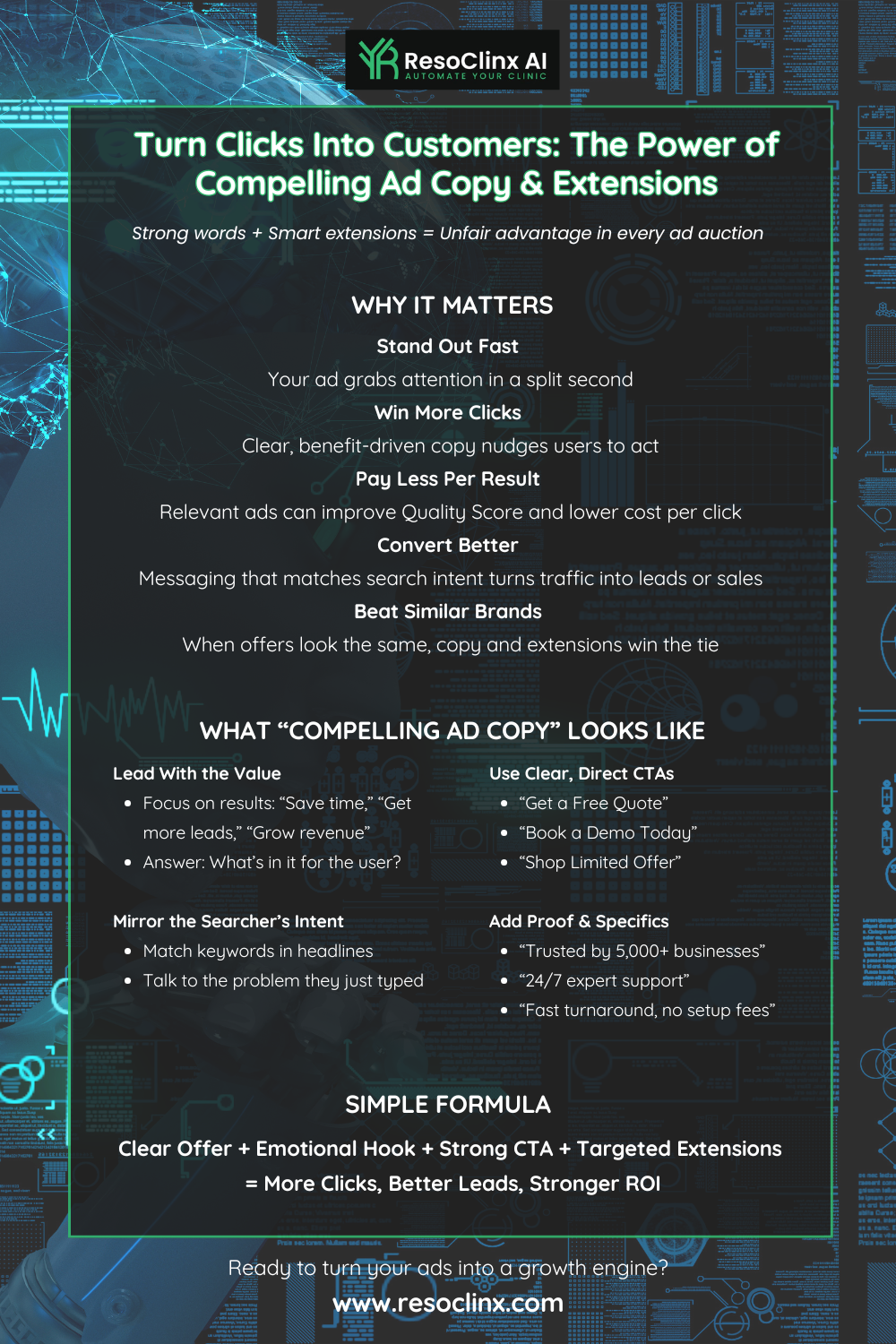
Your ad copy should speak directly to patient motivations and concerns, not just list features. Rather than simply naming the procedure, aim to answer the question: “Why should I trust this clinic with my treatment?”
Focus on:
- Matching search intent and keywords
If someone searches for “rhinoplasty London”, your text should clearly mention rhinoplasty and your location. This makes your ad feel immediately relevant and increases click-through rate. - Highlighting benefits, not just features
Instead of only saying “advanced technology”, you might say “advanced techniques for faster, more comfortable recovery”. Patients care about outcomes, not just equipment. - Using accessible language
Avoid heavy jargon. Even if you use medical terms like “abdominoplasty”, balance them with plain-English explanations so patients feel informed, not intimidated. - Incorporating trust signals
Phrases like “experienced consultant surgeon”, “clinic-led aftercare”, or “regulated facility” help reassure patients that they are dealing with a professional, safe provider.
A good rule is to imagine your ideal patient reading your ad and thinking: “Yes, this sounds like exactly what I am looking for.”
Leveraging Ad Extensions for Increased Visibility
Ad extensions give your ads extra space and functionality on the search results page. They make your listing more useful and can significantly improve click-through rate.
Key extensions for plastic surgery and aesthetic clinics include:
- Sitelink Extensions
These link directly to specific pages on your website, such as “Breast Augmentation”, “Facelift Surgery”, or “Non-surgical Treatments”. They help users quickly find the exact treatment they are interested in. - Call Extensions
On mobile, a tap-to-call button makes it easy for someone ready to enquire to ring your clinic directly from the ad. For many clinics, this is a major driver of consultation requests. - Location Extensions
Showing your clinic address and a map builds local trust and reminds patients that you are within a comfortable travelling distance. - Callout Extensions
Short, punchy snippets like “consultations with a specialist”, “modern, regulated clinic”, or “comprehensive aftercare” allow you to highlight important points without overloading your main ad text.
Used well, ad extensions help your listing occupy more screen space, answer more questions upfront, and make it simpler for potential patients to take action.
Highlighting Surgeon Credentials and Safety Signals
In plastic surgery and cosmetic treatments, trust and safety are absolutely central. Your ads and extensions are an ideal place to reinforce that you operate to high clinical and ethical standards.
Consider including:
- Accreditation and registration – Reference that your surgeons are fully accredited and registered with relevant professional bodies.
- Experience and specialisation – Mention years of experience, or specific areas of expertise such as facial surgery, body contouring, or non-surgical aesthetics.
- Safety and aftercare – Briefly emphasise your focus on patient safety, pre-operative assessment, and post-treatment support.
Make sure any claim in your ads can be fully backed up on your website, in line with Google Ads policies and UK cosmetic advertising guidance. This approach helps you build authority whilst staying compliant and patient-centred.
Strategic Keyword Selection and Targeting
Getting your ads in front of the right people starts with choosing the right keywords. If your terms are too broad, you may pay for clicks from people who are not genuinely interested in your services. If your terms are too narrow, you may miss out on qualified patients.
A structured approach to keywords helps you balance reach and relevance.
Grouping Keywords by Patient Intent
Rather than keeping one long list of keywords, group them according to where the patient is in their decision journey. Each group can then have its own ads and landing pages tailored to that stage.
For example:
- Research / Awareness keywords
Broader terms, such as “cosmetic surgery options” or “breast augmentation information”. These users are exploring but may not be ready to book. Content-led ads and informative pages work well here. - Consideration / Intent keywords
More specific phrases like “rhinoplasty consultation near me” or “lip filler prices London”. These patients are comparing clinics and looking seriously at their options. - Action / Booking keywords
High-intent searches such as “book tummy tuck consultation” or “plastic surgeon appointment London”. Here, your ad and landing page should focus strongly on booking and contact details.
By structuring your campaigns this way, you can adjust bids, budgets, and messages based on how close patients are to making an enquiry.
Utilising Geo-Targeting for Local Reach
Most surgical and aesthetic procedures are location-sensitive. Patients typically want a reputable clinic they can travel to easily, and few will travel long distances unless the treatment is highly specialised.
Geo-targeting in Google Ads allows you to:
- Show ads only within a radius around your clinic
- Target specific towns, cities, or postcodes
- Exclude areas where you do not want to advertise
This helps ensure your budget is spent on people who can realistically visit your clinic, supporting both your Google Ads performance and your broader local SEO for clinics.
Implementing Negative Keywords to Refine Your Audience
Negative keywords are the words or phrases that you do not want your ads to appear for. They are just as important as your main keywords in protecting your budget and keeping your targeting precise.
For example, you might exclude terms like:
- “free plastic surgery”
- “DIY cosmetic procedures”
- “jobs” or “training courses” if you are not recruiting
Adding these as negative keywords prevents your ads from appearing on irrelevant searches, which helps you avoid wasted spend and keep your campaigns focused on genuine patient enquiries.
Optimising Landing Pages for Conversion
Once someone has clicked your ad, the next crucial step is what happens on your landing page. If the page is unclear, slow, or confusing, even the best ad cannot deliver the results you want.
Think of your landing page as the bridge between interest and enquiry. It needs to be professional, informative, and easy to act on.
Designing Dedicated Landing Pages for Specific Procedures
Sending everyone to your homepage is rarely the most effective approach. If a patient searches for “rhinoplasty Manchester” and clicks your ad, they should land on a page that speaks directly about rhinoplasty in Manchester, not a general overview of your entire clinic.
A strong procedure-specific landing page usually includes:
- Clear, procedure-focused headline
For example, “Rhinoplasty (Nose Reshaping) in Manchester”. This immediately reassures visitors they are in the right place. - Concise procedure explanation
A balanced overview of what the procedure involves, who it is suitable for, and typical outcomes, in plain language. - Evidence of experience and quality
Short profiles or statements about the surgeon’s experience with that procedure, plus any relevant credentials. - Supportive visuals
Appropriate use of imagery—such as clinic photos or, where permitted and compliant, before-and-after examples—helps illustrate results without overpromising. - Clear next step
A visible prompt to book a consultation, request more information, or call the clinic directly.
This level of focus makes it easier for a visitor to feel confident that they have found the right service and provider for their needs.
Ensuring a Seamless User Experience
Even the best content will underperform if the user experience is poor. Patients should be able to navigate, read, and enquire without friction.
Key factors include:
- Mobile responsiveness
Most searches now happen on mobiles. Your landing page should display correctly on smaller screens, with easy-to-tap buttons and readable text. - Fast loading speed
Slow pages increase bounce rates. Optimise images and page elements so your content loads quickly and feels responsive. - Simple, logical layout
Use clear headings, short paragraphs, and bullet points where helpful. Make sure contact details and calls-to-action are easy to find. - Straightforward forms
If you use a form, keep it short and simple, asking only for essential information such as name, contact details, and the procedure of interest.
A smooth user experience helps build trust and makes it more likely that a visitor will take the next step and contact your clinic.
Focusing on Clear Calls-to-Action
Every landing page should answer the question: “What do you want the visitor to do next?”
Strong calls-to-action (CTAs) are:
- Visible – ideally above the fold and repeated where appropriate
- Specific – clearly describing the action, for example:
- “Book your consultation”
- “Request a call back from our team”
- “Enquire about this treatment”
You can also offer multiple contact options, such as a phone number, form, and email address, to accommodate different preferences. The more obvious and straightforward the next step is, the higher your chance of turning interest into real enquiries.
Monitoring Performance and Continuous Improvement

Launching your campaigns is only the beginning. To get the best results from Google Ads, you need to monitor performance regularly and make adjustments based on what the data tells you.
This ongoing optimisation is what turns Google Ads from an experiment into a reliable patient acquisition channel.
Tracking Key Metrics: CTR, Conversion Rate, and CPA
There are several core metrics that help you understand how well your ads are working:
- Click-through rate (CTR)
CTR shows the proportion of people who see your ad and then click on it. A low CTR may indicate that your ad copy is not compelling enough, or that your keywords are too broad or not aligned with search intent. - Conversion rate
Conversion rate measures how many clicks turn into a meaningful action, such as a consultation request, phone call, or contact form submission. A high CTR but low conversion rate often means your landing page or offer needs improvement. - Cost per acquisition (CPA)
CPA (or cost per enquiry) tells you how much it costs, on average, to generate a new lead or patient. It is more useful than focusing on cost per click alone, because it reflects the real cost of generating business, not just traffic.
Benchmarks will vary depending on location, procedure, and competition. The most useful approach is to establish your own baseline and then work to improve it over time.
Analysing Search Terms for New Opportunities
In addition to your chosen keywords, Google Ads can show you the actual search terms people used when they saw or clicked your ad. This report is extremely valuable.
From the search terms report, you can:
- Discover new, relevant phrases patients use that you may not have considered, and add them as new keywords.
- Identify irrelevant terms and add them to your negative keyword list to prevent wasted spend.
- Better understand the language and concerns real patients use when searching for treatments like yours.
Regularly reviewing search terms helps you keep your campaigns closely aligned with real patient behaviour, which is key to long-term success.
Making Data-Driven Adjustments for Optimal Results
Once you have data on impressions, clicks, conversions, and search terms, you can start making informed changes.
For example:
- Refine keywords and bids
Increase bids or allocate more budget to well-performing keywords and ad groups. Reduce bids, pause, or remove those that do not convert effectively. - Test new ad variations
Run A/B tests with different headlines, descriptions, and calls-to-action to see which versions resonate best with your audience. - Improve underperforming landing pages
If certain pages have good traffic but poor conversion rates, review them for clarity, trust signals, and calls-to-action. Small changes can produce notable improvements.
By treating your campaigns as ongoing, data-driven projects, you can gradually lower your cost per enquiry and increase the number of genuine patient leads you receive.
Your Google Ads Strategy
Running Google Ads for a plastic surgery or aesthetic clinic can seem complex at first, but breaking it down into clear steps makes it much more manageable. The most effective campaigns:
- Are built on a clear understanding of your ideal patient
- Align ad copy and landing pages with search intent and patient concerns
- Use structured keywords, geo-targeting, and negative keywords to keep targeting tight
- Rely on strong, reassuring landing pages with clear next steps
- Are refined continually using performance data and search insights
When used alongside a strong local SEO strategy and a well-managed Google Business Profile, Google Ads can become a reliable channel for helping the right patients find your clinic at the moment they are actively researching their options.