Thinking about how to promote your beauty salon on Meta (Facebook & Instagram) without breaking the bank? It can feel overwhelming, especially when you see so many ads competing for attention. The good news is, you don’t need a huge budget to get results. What matters is being strategic with your spend and knowing where to focus it.
This guide will walk you through practical, low-waste ways to get your salon (or aesthetic clinic) in front of the right people on Meta. You’ll learn how to:
Make your ads work harder
Create content that actually attracts clients
Improve your local visibility with tools like Google Business Profile
Build stronger relationships with your existing clients
All with a focus on informative, trustworthy marketing, not hard selling.
Key Takeaways
You can start experimenting with Meta ads for your salon with a small budget, such as £50, to see what works before increasing your spend.
Focus your ad efforts on testing different audiences, visuals, and clear calls to action so you can identify what genuinely attracts more clients.
Before-and-after transformations, strong visuals and short videos are powerful on image-led platforms like Instagram and Facebook.
Understanding your ideal client and using Meta’s targeting tools will make your ad spend more effective and reduce wasted budget.
A well-maintained Google Business Profile, along with client reviews and referrals, is a powerful, low-cost way to build trust and support your local SEO..
Leveraging Meta Platforms For Salon Visibility
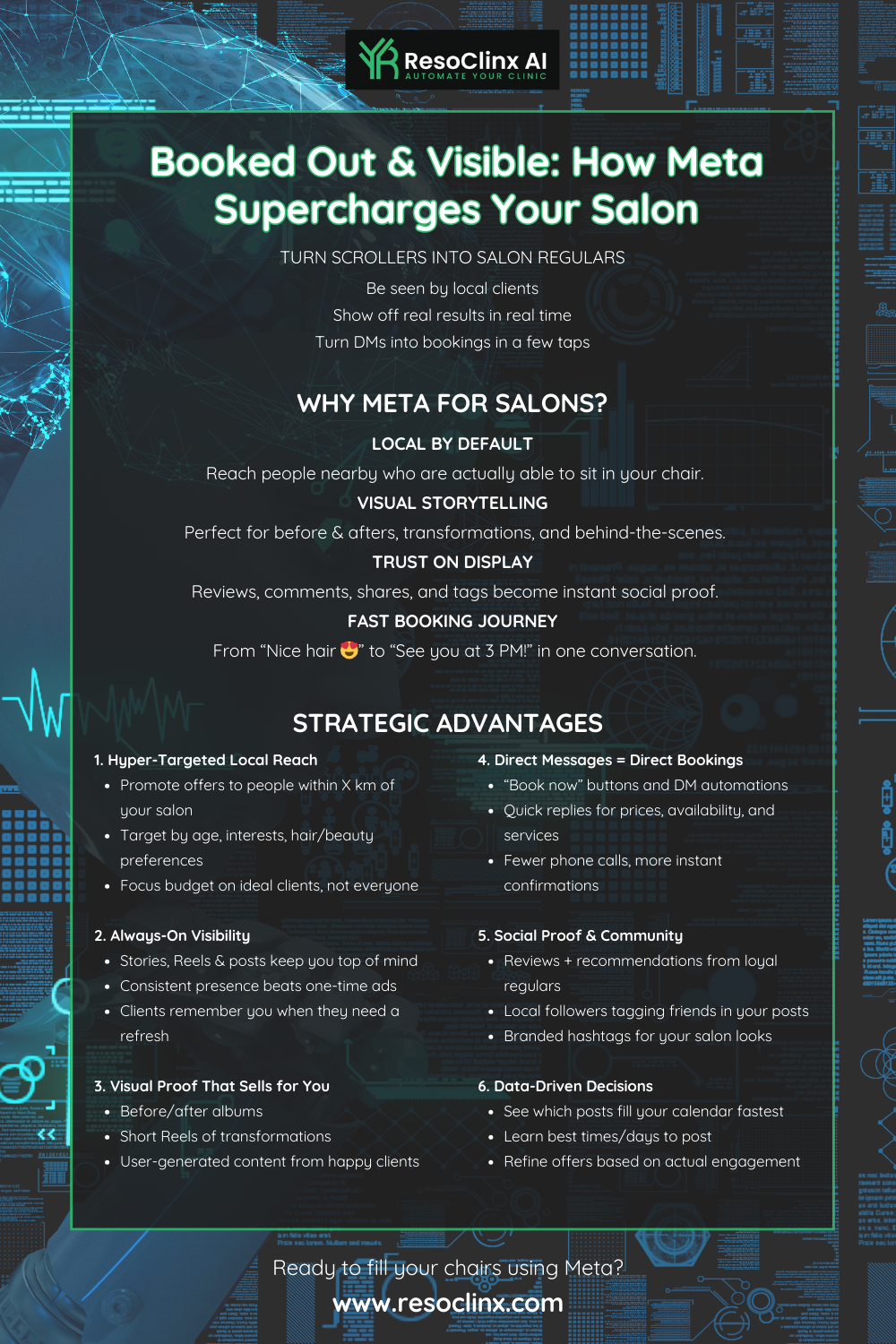
Getting your beauty salon noticed online can feel like a challenge, especially when you want to keep costs under control. That’s where Meta’s platforms – mainly Facebook and Instagram – come in. They’re not just for sharing holiday photos; they are powerful marketing tools that can help your salon or aesthetic clinic be seen by the right local audience without overspending.
When you use Meta with a clear strategy, you move from “posting and hoping” to purposeful, measured activity that supports your wider marketing and local visibility.
Understanding Meta Ads For Salons
Meta Ads (covering both Facebook and Instagram) allow you to place your salon in front of people who are already interested in the kind of services you offer. Instead of shouting into the void, you can use targeted advertising to show ads only to people who are more likely to book.
With Meta Ads, you can:
Target by location (for example, people within a certain radius of your salon)
Refine by age, gender, and interests (beauty, skincare, hair, wellness, etc.)
Reach people based on how they interact with content on Meta
Even a modest budget, such as £50, can give you valuable insight into:
Which images or videos get the most attention
What headlines and texts people respond to
Which audiences are more likely to click through and book
The goal at the start is not to get everything perfect, but to learn quickly without spending a lot.
Strategic Ad Testing On A Budget
When you’re starting with Meta Ads, testing is crucial. You don’t need a large budget to figure out what works – but you do need to test in a structured way.
Begin with small, focused test campaigns:
Try different ad formats – such as carousels showcasing multiple transformations, single-image ads, or short video clips of treatments.
Test different visuals – close-ups of results, full-face or full-hair transformations, or behind-the-scenes shots.
Experiment with several versions of your ad copy – some more educational, others more direct (“Book your consultation”, “Discover our latest skin treatment”).
You can also test different audiences:
Younger clients who want the latest trends and styles
People interested in skin health, anti-ageing, or advanced facials
Busy professionals looking for convenient, high-quality treatments
By running these small tests, you gather data that shows:
Which ads have a good click-through rate (CTR)
Which ads generate more enquiries or bookings
Where your cost per result is lowest
This data-driven approach helps you avoid wasting money on ads that don’t perform, and lets you steadily shift more budget towards what actually works.
Optimising Your Meta Ad Campaigns
Once you’ve collected some data from your test campaigns, your next step is to optimise.
Look carefully at key metrics such as:
Click-through rate (CTR) – Are people clicking your ad?
Cost per click (CPC) – How much are you paying for each click?
Conversions – Are people booking, enquiring, or signing up after clicking?
If an ad is underperforming, don’t let it run unchanged for weeks. Instead:
Adjust the targeting – refine location, age, or interests.
Change the creative – try a different image, video, or headline.
Refine your call to action – be clear on what you want people to do (book, call, message, learn more).
Also, send your ad traffic to relevant landing pages, not just the homepage. For example:
Ads about skin treatments should link to a page describing those treatments and how to book.
Ads about hair colour should take people straight to your colour services or consultation information.
This joined-up approach between your ads and website makes it easier for potential clients to take the next step, helps you track results more accurately, and ensures your ad spend works as hard as possible.
Crafting Compelling Content For Meta
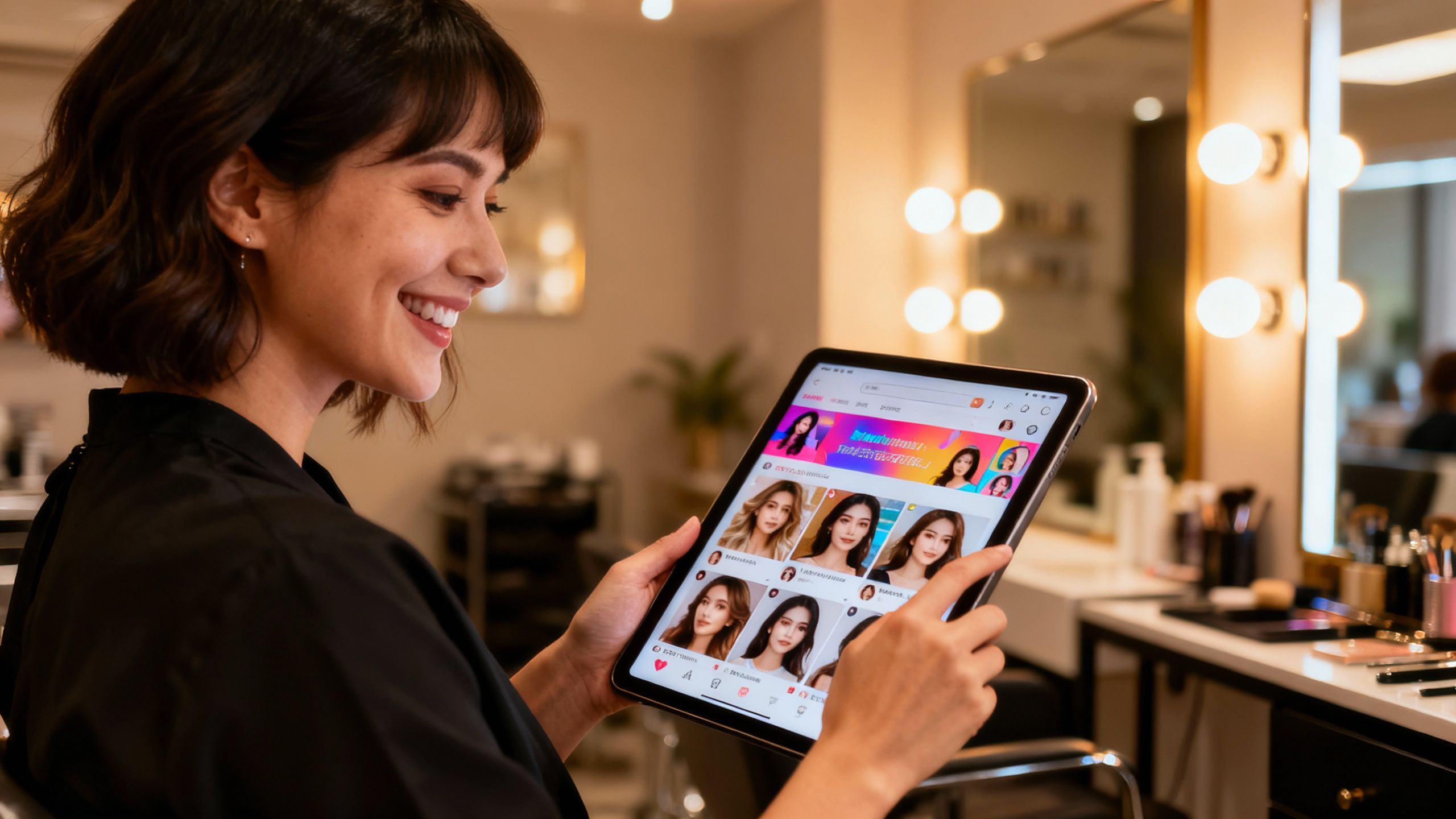
On crowded social feeds, getting your beauty salon noticed on Facebook and Instagram means creating content that stands out quickly. It’s not just about posting regularly; it’s about showing:
What makes your salon or clinic different
The types of results you achieve
The experience and expertise behind those results
Think about what your clients care about most:
Visible transformations
Healthy hair or skin
Feeling more confident, relaxed, and well cared for
The content that performs best usually highlights transformation and the positive feelings associated with your services.
Showcasing Transformations With Before & Afters
Before-and-after photos are incredibly powerful for salons and aesthetic clinics. They provide clear, visual proof of what you can do, and they speak to potential clients more strongly than long descriptions.
To get the most from your before-and-after content:
Be consistent: Use similar lighting, angles and backgrounds for both photos. This makes the change easier to see and more credible.
Get client consent: Always ask for permission before taking and posting photos. Ideally, use a simple consent form so you are covered from a data and privacy perspective.
Highlight the treatment: Add a brief caption explaining what you did, such as “Full balayage and gloss”, “Course of skin rejuvenation facials”, or “Brow shape and tint”.
Stay realistic: Avoid over-editing. Authentic, realistic results build trust and attract clients who value professional standards.
When you share these images regularly, they become a visual portfolio of your work on Meta, helping potential clients imagine their own transformation with you.
Utilising Visuals For Maximum Impact
Beyond before-and-after photos, think about the wider visual story of your salon or clinic.
Useful visual content can include:
Interior and exterior photos – showing your space is clean, welcoming, and professional.
Team photos – introduce your stylists, therapists, or practitioners. People feel more comfortable booking when they can see who will be looking after them.
Treatment-focused visuals – products laid out, a cosy treatment room, or a stylist at work (without showing a client’s face if they prefer privacy).
Simple branded graphics – to share new treatments, seasonal packages, or educational tips on care and aftercare.
Strong visuals make your posts more shareable, more memorable, and more likely to stop someone scrolling long enough to engage with your content.
Engaging Your Audience With Video Content
Video is a fantastic way to bring your salon or clinic to life on Meta. Short videos and Reels can feel more personal and authentic than static images.
Consider creating:
Quick tips: Short clips sharing advice on hair care, skincare routines, aftercare, or how to maintain results between appointments.
Treatment snippets: A few seconds of a facial, blow-dry, colour application, or other treatment, focusing on the process and care.
Day-in-the-life content: A quick look at what happens in a typical day at your salon – setting up, greeting clients, and preparing treatment rooms.
Client testimonials: Short videos where clients (with their permission) talk about their experience and the results they’ve seen.
Video content helps build trust, shows the skill and attention to detail behind your services, and gives potential clients a sense of what it’s like to visit your salon or clinic.
Targeting The Right Audience On Meta

Getting your salon in front of the right people on Meta is essential if you want your advertising budget to work harder. Instead of trying to reach everyone, you focus on those who are most likely to book.
Think of it as similar to your in-salon approach: you wouldn’t promote a complex colour correction to someone who only ever books a quick fringe trim. The same principle applies online.
Defining Your Ideal Client Profile
Before running ads, take time to clearly define your ideal client.
Ask yourself:
What age range are they in?
Where do they live or work?
What kinds of treatments are they most interested in (e.g. balayage, anti-ageing facials, skin rejuvenation, blow-dries, nails)?
What problems are they trying to solve – frizz, acne, dull skin, lack of confidence, little time for self-care?
You can think about this in three areas:
Demographics: Age range, location (critical for local businesses), gender (if relevant).
Psychographics: Interests, lifestyle, values (for example, people who care about wellness, appearance, self-care, and confidence).
Needs & pain points: Are they looking for relaxation, a confidence boost, a solution to a specific hair or skin concern, or preparation for a special event?
When you know exactly who you’re talking to, you can create ads and content that feel more like helpful advice than generic advertising.
Utilising Interest And Behavioural Targeting
Meta’s advertising tools allow you to go beyond age and location and reach people based on their interests and behaviours.
Some useful options include:
Interests: You can reach people interested in topics such as “hair care”, “skincare”, “beauty salons”, “aesthetic treatments”, or broader areas like “wellness” and “fashion”.
Behaviours: You can target people who often engage with beauty content, regularly shop online, or are active in your local area.
Location targeting: For salons and clinics, this is essential. You can set a radius around your postcode or target specific nearby communities while excluding areas that are too far away to be practical.
Start with a small set of highly relevant interests that align closely with what you specialise in. You can always expand later based on performance data.
Leveraging Lookalike Audiences Effectively
Once you have some data – or if you have a list of existing clients – you can use Lookalike Audiences to find more people similar to your best customers.
Typically, you will:
Create a source audience: This could be your email list, website visitors (if you use a pixel), or people who frequently engage with your content on Facebook or Instagram.
Ask Meta to find similar people: Meta will identify users who share similar characteristics and behaviours to the people in your source audience.
Choose your size: Smaller percentages (for example, the top 1–3% most similar) tend to be more precise, while larger audiences are broader.
Lookalike Audiences help you remove guesswork and expand your reach to people who resemble your existing happy clients, often at a cost-effective rate.
Maximising Your Salon’s Online Presence
It’s not enough to offer excellent treatments; people also need to be able to find you easily online. Your online presence acts as your digital shop window – if it’s unclear or out of date, potential clients may simply scroll past or choose a competitor.
To maximise your online presence, focus on:
A strong, accurate Google Business Profile
A clear, user-friendly website
Online reviews and reputation management
These elements support both your Meta activity and your local SEO, helping people discover you when they search for services in your area.
Optimising Your Google Business Profile
Your Google Business Profile (GBP) is often the first place people look when searching for a local salon or aesthetic clinic. It acts as your digital business card on Google Search and Maps.
Make sure your profile is:
Complete and accurate: Double-check your address, phone number, website, and opening hours (including bank holidays or seasonal changes).
Visually appealing: Upload high-quality photos of your interior, exterior, treatments (with consent), and results. Before-and-after images work well here too.
Service-focused: List your key services clearly – for example, “women’s cuts”, “men’s cuts”, “colour correction”, “laser hair removal”, “anti-ageing facials”, rather than one generic word like “hair” or “skincare”.
Updated regularly: Use the Posts feature to share updates such as new treatments, changes in hours, educational tips, or links to your latest blog posts.
A well-optimised Google Business Profile makes it easier for people in your local area to find you, see what you offer, and feel confident enough to contact or book with you.
Enhancing Your Salon’s Website
Your website is your online home base. It’s where people go to:
Learn more about your services
See your prices or treatment options
Understand how to book or get in touch
To make your website work effectively alongside Meta:
Ensure it has clear navigation, so visitors can quickly find services, pricing, about information, and contact details.
Include detailed service descriptions, outlining what clients can expect, who treatments are suitable for, and how often they may need appointments.
Use strong visuals – images or a short video tour to reflect the look and feel of your salon or clinic.
Make the site mobile-friendly, as many visitors will be viewing on their phone.
Add clear calls to action, such as “Book an appointment”, “Request a consultation”, or “Call the salon”.
If your website looks polished, professional and easy to use, it reinforces the message that your services are high quality and trustworthy.
Encouraging And Managing Online Reviews
Online reviews are the digital version of word-of-mouth recommendations. For many clients, they are a key part of deciding whether to trust a new salon or clinic.
To manage reviews effectively:
Ask for reviews: After a positive visit, gently encourage clients to leave a review on Google, Facebook, or other relevant platforms. A simple request at the end of an appointment or in a follow-up message can be very effective.
Make it easy: Provide a direct link to your review page in confirmation emails, reminder texts, or on social media.
Respond professionally: Thank people for positive reviews, and respond calmly and constructively to negative feedback, showing you take client experience seriously.
Learn from feedback: If you spot patterns – for example, repeated praise for a particular treatment or concerns about waiting times – use that insight to improve your service.
Consistent, genuine reviews build trust and credibility, and they also support your local search visibility.
Building Client Relationships Through Meta
It’s tempting to focus on constantly attracting new clients, but your existing clients are often your most valuable asset. Meta offers several low-cost tools to help nurture these relationships.
By using Meta to keep in touch, you can:
Stay top of mind between appointments
Share useful advice that clients appreciate
Encourage repeat visits and referrals
This makes your marketing more sustainable and often more affordable than always chasing new bookings.
Implementing Client Retention Strategies
Client retention is about making people feel recognised and valued, not just treated as another appointment slot.
Consider using Meta to support:
A simple loyalty programme, where clients receive a discount or complimentary add-on after a certain number of visits.
Maintenance packages, for example a monthly colour top-up, a facial plan, or a regular blow-dry package, giving clients convenience and predictable costs.
VIP-style updates, where your Meta followers hear first about new treatments, seasonal experiences, or educational events you’re running.
When promoted carefully through your Meta content, these initiatives can:
Encourage clients to return more regularly
Increase the lifetime value of each client
Give clients a sense of being part of your salon community
Utilising Meta For Direct Client Communication
Meta isn’t just a broadcast platform; it also enables two-way communication through direct messages and comments.
You can use this to:
Answer quick questions about treatments, pricing, or availability.
Offer simple guidance or aftercare when clients message with concerns or follow-up questions.
Send friendly reminders or follow-ups when someone has asked about a treatment but not yet booked.
Used professionally and respectfully (without being intrusive), direct messaging can:
Help potential clients overcome hesitations
Make existing clients feel looked after
Turn casual followers into loyal, long-term customers
Encouraging Referrals And Loyalty
Your happiest clients can become your strongest advocates on Meta.
To encourage referrals:
Create a simple referral arrangement where both the existing client and the person they recommend receive a small benefit (for example, a discount on a future service or a complimentary upgrade).
Ask satisfied clients if they are comfortable with you sharing their testimonial, photo, or short video on your page.
Encourage clients who are active on social media to tag your salon or use a branded hashtag when they post about their visit.
This kind of user-generated content is often perceived as more authentic than advertising and helps to reinforce your reputation as a trusted local business.
Measuring Success And Refining Your Strategy

With day-to-day salon life being so busy, it’s easy to post ads and content and hope for the best. But without looking at your results, you might be spending time and money without knowing what’s truly effective.
Measuring performance doesn’t have to be complicated. A simple habit of checking core metrics will help you:
See what’s working
Spot what’s not
Make better decisions about where to invest your budget and effort
Tracking Key Performance Indicators
Some of the key performance indicators (KPIs) to monitor include:
Reach: How many unique people saw your post or ad.
Impressions: How many times your ad or post was shown (including multiple views by the same person).
Click-through rate (CTR): The percentage of people who clicked your ad after seeing it.
Cost per click (CPC): How much you paid, on average, for each click.
Conversions: The meaningful actions people take after clicking (for example, online bookings, contact form submissions, or calls).
Cost per conversion: How much you spent to get each booking or enquiry.
You don’t need to obsess over every single metric, but understanding these basics will allow you to compare campaigns fairly and see where your return on investment is strongest.
Analysing Ad Performance Data
Once you know what to track, you need to actually look at the data. Meta provides a lot of information in its Ads Manager, and it can seem a bit much at first. But don’t let it scare you off. Start simple.
Look at your recent campaigns. Which ones had the best CTR? Which ones led to the most bookings? Were there any ads that had a really high cost per conversion? These are the questions you need to be asking.
Here’s a quick way to see what’s happening:
Campaign Name | Spend (£) | Reach | Clicks | Conversions | Cost Per Conversion (£) |
|---|---|---|---|---|---|
Summer Offer | 150 | 5,000 | 250 | 15 | 10.00 |
New Client | 100 | 3,500 | 180 | 10 | 10.00 |
Loyalty Promo | 75 | 2,000 | 100 | 5 | 15.00 |
This kind of table helps you quickly see which campaigns are performing well and which ones might need a rethink. The ‘Summer Offer’ and ‘New Client’ campaigns are doing okay, but the ‘Loyalty Promo’ is costing more per booking.
Don’t just look at the numbers in isolation. Think about the goal of each campaign. Was it to get new clients, or to encourage existing ones to come back? The success metrics should match the objective.
Adapting Your Approach Based On Insights
The final step is using what you’ve learned to improve future activity.
Based on your data, you can:
Double down on what works: If certain images, videos, or offers consistently perform well, use them more often or adapt them for new campaigns.
Refine or pause weak campaigns: If something is underperforming, adjust the audience, change the creative, or pause it altogether to protect your budget.
Test new ideas: Use insights from past performance to guide new experiments – for example, trying a different visual style, new audience segment, or fresh type of content.
Meta’s platforms and your clients’ behaviour will evolve over time. By reviewing your results regularly and being willing to adapt, you’ll keep your marketing effective, efficient, and aligned with your business goals.
Putting It All Together
Promoting your beauty salon on Meta does not need to be a money pit. By focusing on smart, targeted strategies, you can:
Increase your visibility
Attract more clients
Strengthen your local presence
All without needing a huge budget.
The key is to:
Create content that speaks to their needs and desires
Use Meta’s tools – including targeting, ads, and messaging – in a way that supports your broader marketing and local SEO efforts
Measure your results and refine your approach over time
Start with a modest budget, track what happens, and use the insights to gradually improve. Over time, this consistent, thoughtful approach will help you build a stronger, more visible, and more trusted brand online.