
Deciding between an in-house marketing team and an external agency can feel like a big decision for any aesthetic clinic. Both have clear advantages and limitations, and what works best ultimately depends on your clinic’s goals, resources, and stage of growth.
In this guide, we’ll break down the in-house vs agency marketing debate so you can decide what’s right for your business and structure your aesthetic clinic marketing in a way that supports sustainable, long-term growth, not just short-term promotion.
Key Takeaways
An in-house team offers direct control and deep integration with clinic operations, helping you build internal marketing expertise over time.
Agencies provide access to specialised skills, tools, and scalability, along with more objective market insights.
The decision hinges on factors like budget, clinic size, local competition, growth goals, and the need for measurable, trackable results.
A hybrid approach, combining internal efforts with agency support, can often provide the best balance of control, expertise, and flexibility.
Future marketing success for aesthetic clinics requires adapting to AI-driven search, local SEO for clinics, and prioritising long-term visibility over short-term gains.
Understanding The In-House vs Agency Marketing Debate
Choosing how to manage your clinic’s marketing is a significant decision, and it often comes down to two main paths: building an in-house team or partnering with an external agency. Both approaches have a distinct set of benefits and drawbacks, and what works best depends on your clinic’s specific situation, goals, and resources.
It’s not a simple ‘one-size-fits-all’ answer. Instead, it is about understanding:
How much control you want over your brand day to day
What skills you already have internally
How quickly you need to see results
How you plan to grow in the next 12–24 months
Understanding the core differences between in-house and agency marketing is the first step towards making an informed, confident decision for your clinic.
Defining In-House Marketing Teams
An in-house marketing team means you hire your own staff to handle your clinic’s promotional activities. This could be a single marketing manager or a dedicated team of specialists, depending on your clinic’s size and budget.
The key advantage here is direct control. Your team is embedded within the clinic, giving them a deep, day-to-day understanding of your services, your practitioners, and your patient experience. They see what happens in the waiting room, hear the questions patients ask, and understand the nuances of your treatment menu.
This proximity can lead to more authentic and integrated marketing messages. Your in-house team lives and breathes your brand, so they can ensure consistency and accuracy across everything from website copy and blog posts to social media content and email campaigns.
However, building and maintaining an in-house team requires ongoing investment in salaries, training, and tools. It also means you’re responsible for keeping their skills up to date, especially in a rapidly changing digital marketing landscape that includes social media, paid advertising, local SEO, and AI-driven search.
Defining Agency Marketing Services
Marketing agencies are external companies that offer a range of services to multiple clients. They typically employ a team of specialists with diverse skills, including SEO, social media management, paid advertising, content creation, design, and sometimes web development and analytics.
Partnering with an agency can give your clinic access to a broad range of expertise and tools that might be too costly or impractical to develop in-house. Agencies can often implement campaigns quickly, test new ideas, and provide a fresh, objective perspective on your marketing efforts.
The trade-off is that you have less direct control, and the agency’s understanding of your clinic may initially be more surface-level compared to an internal team. You also pay for a service, rather than building an internal asset: when you stop working with the agency, some momentum and knowledge may leave with them.
For many clinics, the key question is not whether agencies are “better” than in-house teams, but how to use agency support strategically to complement internal resources.
The Evolving Landscape of Digital Marketing
The world of digital marketing for aesthetic clinics is constantly shifting. What worked two or three years ago may now be less effective. We are seeing a significant move towards AI-driven search and content consumption. Patients increasingly use conversational queries to ask detailed questions about treatments, safety, downtime, and results.
This means that traditional tactics, such as simply optimising for keywords, are no longer enough on their own. Aesthetic clinics need to consider how their content is:
Structured
Clear and semantic
Technically accessible to search engines and AI systems
Your content needs to be understood and trusted by AI systems as well as human readers. This evolving landscape adds another layer of complexity when deciding between in-house and agency, because both models must be able to adapt to new technology and support long-term discoverability and trust.
The core challenge for any clinic today is not just who does the marketing, but how the marketing is structured so that it is discoverable, trustworthy, and sustainable in an AI-influenced world. That requires a focus on robust digital infrastructure, not just individual campaigns.
Evaluating The Strengths Of An In-House Marketing Approach

Bringing your marketing efforts under your own roof, with an in-house team, offers a distinct set of advantages for aesthetic clinics. It is about having your brand’s voice, content, and campaigns managed by people who are deeply embedded within your clinic’s culture and daily rhythm.
Direct Control Over Brand Messaging
One of the most significant benefits of an in-house team is the unparalleled control you have over your brand’s narrative. Your internal team is on the front line, interacting with patients and clinicians every day.
This proximity allows them to capture:
Authentic patient stories and testimonials
The unique approach of your practitioners
The subtle differences in how you deliver treatments compared to competitors
This intimacy translates into marketing messages that are accurate, consistent, and aligned with your clinic’s values. Unlike an external agency that might rely on periodic briefings, your in-house team lives and breathes your brand, ensuring cohesion across all communications, from your website and blog to your social media and email marketing.
For aesthetics specifically, this can make it easier to produce educational content that feels genuinely helpful rather than promotional, supporting your position as a trusted, knowledgeable clinic.
Deeper Integration With Clinic Operations
An in-house marketing team is not just an external function; they become an integral part of your clinic’s operations. They can:
Work closely with reception to understand patient journey pain points
Collaborate with practitioners to highlight new treatment protocols or technologies
Support the refinement of the patient experience from first enquiry to post-treatment follow-up
This level of integration means marketing strategies are developed with a real-time understanding of what’s working, what’s not, and where new opportunities are emerging within the clinic.
For example, if your team identifies that a particular treatment has frequent questions around downtime or suitability, they can quickly create a blog post, FAQ, or short video to address this. That kind of responsiveness is much easier when marketing is embedded in the clinic.
Building Internal Expertise And IP Ownership
Investing in an in-house marketing team means cultivating valuable skills and knowledge within your organisation. Over time, your team will build a deep understanding of your local market, patient base, and performance data, which becomes a form of intellectual property (IP).
As they develop campaigns, analyse data, and refine strategies, they create:
Tailored processes for your clinic
Reusable content and frameworks
A clear sense of what works best for your specific audience
Unlike working with an agency where some knowledge stays external, an in-house team builds this IP for your clinic to own. This reduces long-term reliance on external partners and allows you to grow a strategic marketing capability that is entirely yours.
For clinics with long-term ambitions, building internal expertise can be a way to ensure that your brand voice, patient education, and marketing systems become stronger year after year.
Exploring The Advantages Of Partnering With An Agency
Sometimes, bringing in an external marketing agency can feel like a breath of fresh air for an aesthetics clinic. It is not about admitting defeat with an in-house team, but about recognising when specialised help can make a meaningful difference.
Agencies typically come with a ready-made toolkit and a team of people who live and breathe marketing, which can be a significant asset when you are focused on clinical quality and patient care.
Access To Specialized Expertise And Tools
Marketing is a broad and complex field. An agency usually employs specialists in areas such as:
Search engine optimisation (SEO) and local SEO for clinics
Social media management and content planning
Paid advertising (Google Ads, Meta Ads, etc.)
Content creation (blogs, video scripts, graphics)
Analytics and reporting
You are not just buying “general marketing”; you are tapping into a deep well of expertise that would be expensive and time-consuming to build in-house.
Agencies also tend to invest in advanced marketing tools, including:
Analytics platforms
Reporting dashboards
Design and video software
Call tracking and attribution tools
These tools can help you measure performance accurately, optimise campaigns, and understand what is really helping you attract more clients.
This level of specialised skill and tooling can make your marketing efforts more effective and efficient, particularly if your clinic is at a stage where you need faster growth or more sophisticated campaigns.
Scalability And Rapid Implementation

One of the biggest advantages of working with an agency is their ability to scale up or down quickly. If you are launching a new treatment, running a seasonal campaign, or opening a new location, an agency can often mobilise resources faster than an in-house team.
When you partner with an agency, you’re essentially borrowing their infrastructure and expertise. This allows for a much quicker rollout of marketing initiatives compared to building everything from scratch internally. You can test new ideas, run larger campaigns during peak periods, or scale back if needed, without the complexities of hiring or reducing staff.
This makes agency support a flexible solution that can adapt to your clinic’s changing needs and growth phases.
Objective Market Insights And Performance Tracking
Agencies bring an outside perspective that can be very valuable. Because they are not immersed in your clinic’s daily routines, they can look at your marketing performance with fresh eyes. They can:
Identify market trends
Analyse competitor activity
Highlight opportunities you may not have considered
Most reputable agencies are also highly focused on tracking and reporting key performance indicators (KPIs). They will aim to show you exactly how your marketing spend is performing, what is working, and what is not.
Common metrics include:
Website traffic and sources (e.g., Google, social media, direct)
Lead generation: the number of enquiries and consultation requests
Conversion rates: how many leads become bookings
Return on ad spend (ROAS) and cost per acquisition (CPA)
This data-led approach encourages accountability and allows for continuous refinement of your marketing strategy so that your budget is used as effectively as possible.
Key Considerations For Aesthetics Clinics
Before deciding whether to invest in an in-house team, an agency, or a hybrid approach, it helps to step back and look at a few practical foundations.
The right structure for your aesthetic clinic marketing depends on factors such as budget, capacity, growth plans, and how you want to position your clinic in the local market.
Budgetary Allocations and Resource Management
When you review your marketing, it is easy to be drawn towards new tools, channels, and trends. However, before committing to either an in-house hire or an agency retainer, it is important to have a clear, realistic budget.
Consider:
How much can you consistently invest in marketing each month?
Which costs are fixed (e.g., software) and which are variable (e.g., ad spend)?
How much internal time is realistically available for marketing tasks?
Using existing internal talent can be a cost-effective way to start. For example, a team member who is confident on social media or enjoys writing can contribute to authentic, patient-focused content.
Sometimes, a smaller, more focused budget spent wisely can produce better results than a larger, fragmented one. For many aesthetic clinics, this includes prioritising:
Local SEO for clinics
A technically sound website
A well-optimised Google Business Profile
Consistent patient education content (blogs, FAQs, guides)
Allocating budget to these core elements creates a foundation that supports any future campaigns, whether managed in-house or via an agency.
Clinic Size and Growth Objectives
Your clinic’s current size – and where you want it to be – plays a major role in deciding your marketing approach.
For smaller clinics or solo practitioners, the focus may be on:
Building local awareness
Attracting those first crucial patients
Establishing a clear online presence
This often involves local SEO, a strong Google Business Profile, and consistent, helpful content that helps you attract more clients without relying solely on discounts or short-term offers.
For larger clinics or multi-location centres, the goals may include:
Expanding into new service areas
Attracting a more specific or premium clientele
Increasing patient retention and lifetime value
In these cases, marketing may need to be more sophisticated, with a mix of paid advertising, email nurture sequences, advanced analytics, and potentially brand-building campaigns.
Think about your growth trajectory:
Are you aiming for steady, organic growth?
Do you want to scale quickly in your region?
Are you positioning your clinic as a premium, specialist provider?
Your answers will guide whether you need more hands-on internal control or broader external expertise.
Navigating The Decision: In-House vs Agency Marketing
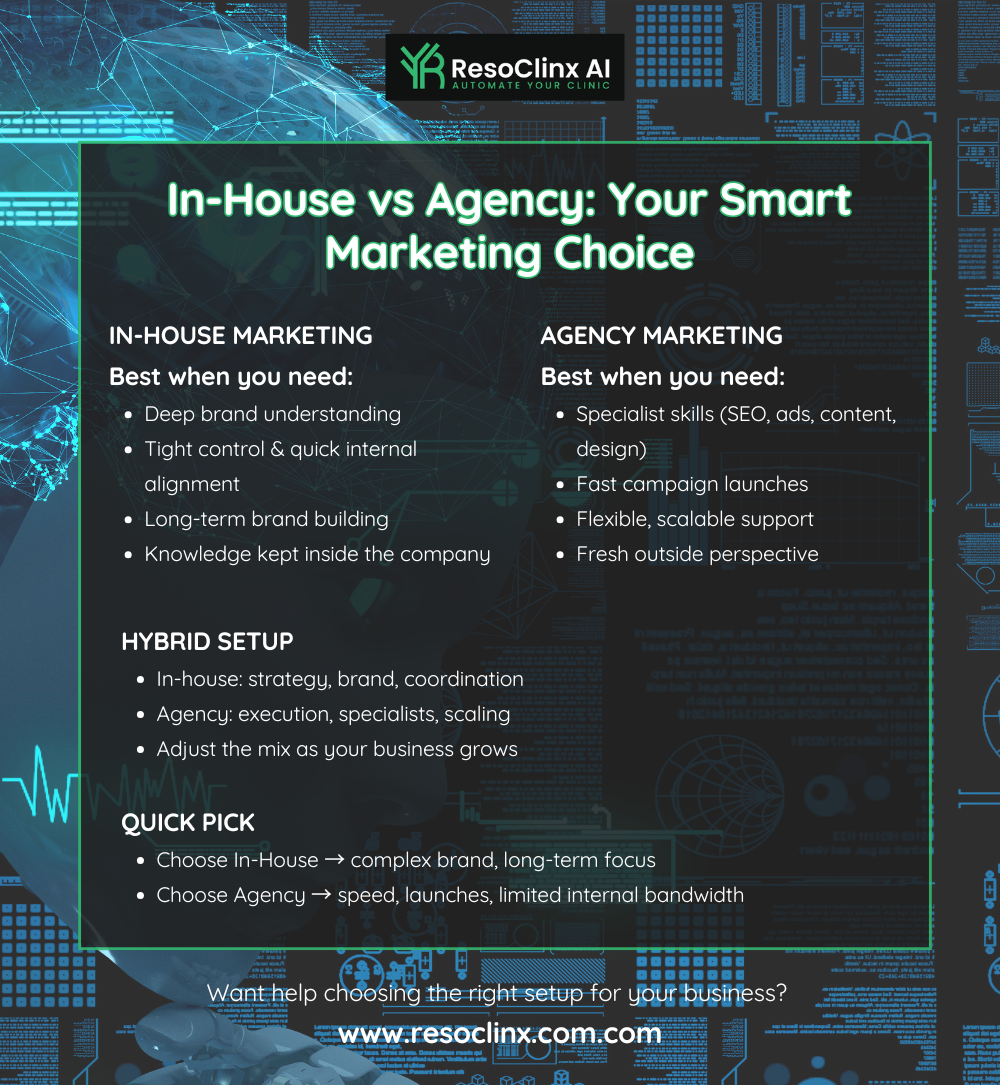
So, you’re weighing up whether to build your own marketing team or hire an agency. It’s a significant decision, and the best option is the one that fits your clinic’s circumstances, resources, and growth plans.
Ultimately, the most effective marketing strategy is not about choosing between in-house or agency alone; it is about building a system that consistently attracts and retains the right patients for your clinic through sustainable aesthetic clinic marketing.
Assessing Your Clinic’s Unique Needs
Before making any commitments, take a clear, honest look at your clinic:
Current marketing efforts: What is working well? What feels reactive or ineffective?
Patient demographic: Who are you trying to reach, and what do they care about?
Service mix: Do you offer a few specialist treatments or a wide range of services?
Internal capacity: Who in your team can realistically contribute to marketing?
Budget: What can you invest now, and what do you need to see in return?
This assessment will help you identify whether you need more strategic guidance, hands-on execution, or both.
The most effective marketing strategy isn’t about choosing between in-house or agency; it’s about building a system that consistently attracts and retains the right patients for your clinic.
Finding the Right Fit for Your Marketing Strategy
Once you have a clearer picture of your needs, patterns begin to emerge.
An in-house team may be a better fit if:
You want tight control over brand messaging
You value day-to-day integration with clinic operations
You are prepared to invest in ongoing training and development
An agency may suit you better if:
You require specialised skills in multiple areas (SEO, paid ads, design)
You need to move quickly with campaigns and launches
You prefer to outsource execution while you focus on clinical work
Neither option is inherently “better”; the right choice is the one that supports your clinical, financial, and strategic goals.
A Hybrid Approach for Optimal Outcomes
Many successful aesthetic clinics find that a hybrid model works best.
For example:
An in-house team member manages social media, patient emails, and day-to-day communication
An agency handles web development, paid advertising, advanced analytics, or occasional campaigns
This approach gives you:
The brand intimacy and responsiveness of an in-house presence
The breadth of skills and scalability that agencies can provide
A hybrid model also allows you to adapt over time. As your clinic grows, you can shift responsibilities between in-house staff and agency partners, gradually building the mix that delivers reliable, measurable results.
Future-Proofing Your Marketing Strategy
The clinics that will thrive in the coming years are those that treat marketing as a long-term system, not just a sequence of short-lived campaigns.
Adapting to AI and Evolving Search Trends
Simple keyword searches are no longer the only way patients discover services. Increasingly, people use conversational queries, and AI-driven tools are playing a growing role in how clinics are found online.
This means your clinic’s online presence needs to be:
Structured clearly
Written with semantic clarity
Technically prepared for both search engines and AI systems
Think of your website and content as something that should make sense to both patients and machines. Clear headings, well-organised pages, and content that directly answers common patient questions are all crucial.
Prioritising Long-Term Visibility Over Short-Term Gains
Short-term campaigns, such as a brief discount or a single ad push, can generate quick results. However, sustainable success usually comes from longer-term visibility.
This involves focusing on:
High-quality, educational content that builds trust
Optimised service pages and treatment guides
A consistently updated Google Business Profile
Strong local SEO signals (reviews, local citations, on-page optimisation)
Instead of just chasing rankings, think in terms of retrievability: can your clinic be found when someone asks a detailed question about a treatment, concern, or outcome?
This approach builds a more durable online presence that does not rely solely on continuous ad spend.
Building Sustainable Marketing Infrastructure
Think of your marketing not just as campaigns, but as a system. That system includes several key elements:
Structured data: Implementing schema markup across your site helps search engines and AI understand your services, locations, and expertise.
Semantic clarity: Using clear, precise language helps both patients and AI understand your content.
Technical foundation: A well-optimised, fast, secure website that is easy to crawl and navigate is essential.
Content relevance: Informative, accurate content that answers patient questions builds authority and trust.
The shift towards AI means that traditional marketing tactics alone might not be enough. Clinics need to invest in the underlying structure of their online presence to ensure they remain discoverable and trusted by both patients and the AI tools they use. This is about building for the future, not just the present.
Here’s a simple comparison:
Feature | Traditional SEO/Marketing | AI-Native Infrastructure |
|---|---|---|
Focus | Ranking pages | AI retrievability & trust |
Content Approach | Keyword stuffing | Semantic clarity & schema |
Implementation | Campaign-based | Systemic & ongoing |
Goal | Traffic acquisition | Patient discovery & trust |
Finding Your Clinic’s Marketing Sweet Spot
Whether you’re leaning towards building your own in-house marketing capability or partnering with an external agency, the key takeaway is that a clear, consistent, and well-executed strategy is non-negotiable for your aesthetics clinic.
Both approaches have their merits, and the “best” choice really depends on your clinic’s needs, budget, local competition, and growth ambitions. Do not be afraid to start small, track your results carefully, and adapt as you learn. Whichever path you choose, focus on authenticity, clarity, and patient value, and you will be well positioned to build a thriving, sustainable practice.