

Understanding whether your marketing automation is delivering a meaningful return can be challenging. When you’re investing in software, training, and ongoing implementation, it’s important to know whether these efforts genuinely contribute to increased patient enquiries, higher conversion rates, and stronger long-term revenue.
This guide explains how aesthetic clinics can measure the ROI of marketing automation, what metrics matter most, and how to build a framework that supports clear, data-driven decisions.
Key Takeaways
- Clear KPIs are essential for measuring ROI accurately.
- Automation supports patient acquisition by guiding leads from awareness to booking.
- Your automation investment should translate into more treatment bookings and higher revenue.
- Retention-focused automation helps maintain long-term patient relationships.
- Tools such as CRM integration and call tracking are critical for accurate attribution.
Establishing Your Marketing Automation ROI Framework
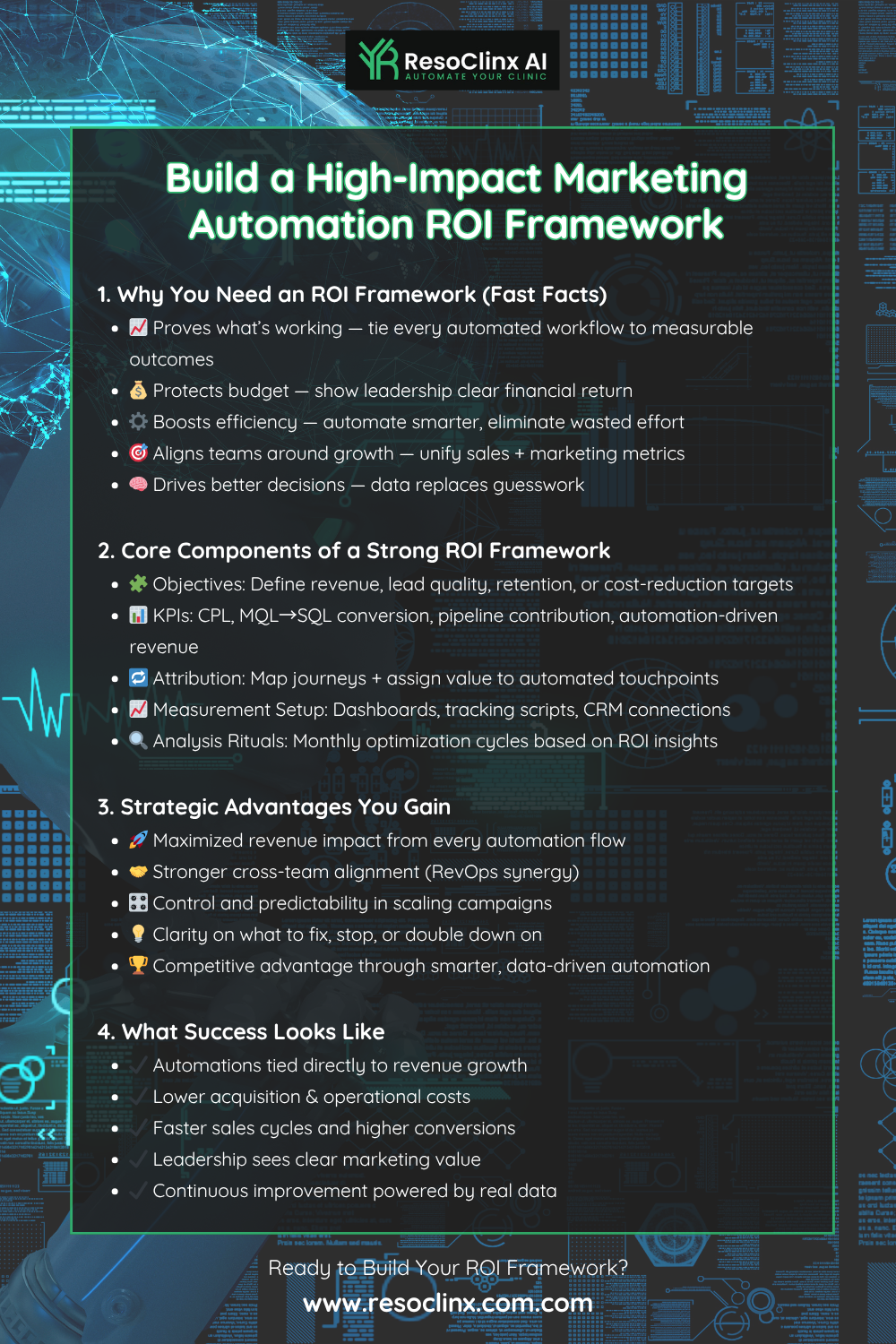
A structured approach ensures that every automated workflow contributes to measurable outcomes. Without a clear framework, attribution becomes inconsistent and difficult to analyse.
Defining Key Performance Indicators for Automation Success
KPIs provide a foundation for evaluating success. Common KPIs for aesthetic clinics include:
- Lead Quality Score – Identifies how likely a lead is to convert.
- Conversion Rate – Measures how many leads complete a goal (e.g., booking a consultation).
- Email Open Rate & Click-Through Rate (CTR) – Shows engagement with automated content.
- Cost Per Lead (CPL) / Cost Per Acquisition (CPA) – Key for budgeting and campaign efficiency.
- Patient Lifetime Value (LTV) – Essential for understanding long-term profitability.
These metrics help you determine how effectively your automation contributes to aesthetic clinic marketing goals.
Aligning Automation Goals with Business Objectives
Marketing automation must support your clinic’s wider objectives. If your goal is to increase anti-wrinkle treatment bookings, for example, automation might include:
- Targeted nurture sequences for users interested in injectables.
- Automated follow-up reminders for previous patients.
- Re-engagement emails for patients who have not booked in several months.
Aligning workflows with business goals ensures every automated message has a purpose.
Understanding the Lifetime Value of Automated Leads
Automation helps build long-term relationships. A patient may begin with a consultation but return for:
- Injectables
- Skin treatments
- Laser services
- Maintenance programmes
Tracking Lifetime Value reveals the full financial contribution of leads sourced and nurtured through automation. It shifts the focus from single appointments to sustained revenue.
Quantifying the Impact of Automation on Patient Acquisition
So, you’ve got your marketing automation set up, but how do you know if it’s actually bringing in new patients? It’s not enough to just send out emails; you need to see the results. This is where tracking your lead generation through automated workflows becomes really important.
When someone fills out a contact form on your website, or downloads a guide about a specific treatment, that’s a lead. Marketing automation can then kick in, sending them a welcome email, maybe some more information about that treatment, or even an invitation to a consultation.
The key is to track where these leads came from and what happened next.
Tracking Lead Generation Through Automated Workflows
Your automation platform should give you insights into how many new leads are entering your system and which specific workflows they’re going through. For example, you might have a workflow for ‘new patient enquiries’ and another for ‘interested in laser treatments’. By monitoring these, you can see which marketing efforts are attracting the most potential patients.
Your automation platform should display:
- How many leads enter each workflow
- Which treatments they’re interested in
- How they engage with your messages
It’s also helpful to see how engaged these leads are. Are they opening your emails? Clicking on links? Responding to messages? This tells you if your automated content is actually hitting the mark and keeping them interested.
Measuring Conversion Rates from Automated Campaigns
This is where we get down to brass tacks. A conversion, in this context, is when a lead takes a desired action, like booking a consultation or making an enquiry about a specific treatment.
Your automation platform, ideally linked to your CRM, should be able to tell you how many leads from a specific automated campaign actually converted.
For instance, if you ran a campaign offering a free consultation for a new facial treatment, you’d want to know how many people who received those automated emails actually booked that consultation.
A simple table can help visualise this:
| Campaign Name | Leads Generated | Consultations Booked | Conversion Rate |
|---|---|---|---|
| Free Facial Consultation | 250 | 35 | 14% |
| Laser Hair Removal Info Pack | 180 | 20 | 11.1% |
This kind of data shows you which campaigns are most effective at turning interest into actual appointments.
Calculating Cost Per Acquisition with Automation
To figure out your Return on Investment (ROI), you need to know how much it costs to get a new patient. Marketing automation can actually help reduce this cost.
Here’s a basic way to think about it:
- Calculate your total marketing automation costs: This includes the software subscription, any setup fees, and the time your team spends managing it.
- Identify the number of new patients acquired through automation: This is the number of patients who came in directly because of your automated campaigns.
- Divide total costs by the number of new patients: This gives you your Cost Per Acquisition (CPA) for automated leads.
The goal is to see this CPA decrease over time as your automation becomes more efficient. If your CPA is going up, it might mean your workflows need tweaking or you’re not targeting the right audience.
By carefully tracking these metrics, you can move beyond guesswork and truly understand how your marketing automation is contributing to the growth of your aesthetics clinic. It’s about making data-driven decisions to bring more patients through your doors.
Measuring Revenue Growth Driven by Marketing Automation

Marketing automation isn’t just about sending emails; it’s a powerful engine for driving tangible revenue growth in your aesthetics clinic. By carefully tracking how your automated campaigns influence bookings and sales, you can get a clear picture of your return on investment.
It’s about turning those initial leads into loyal patients who contribute significantly to your clinic’s bottom line.
Attributing Treatment Bookings to Automated Nurturing
One of the most direct ways automation impacts revenue is by nurturing leads until they’re ready to book. Think about a potential patient who downloaded a guide on laser hair removal. Your automation platform can then send a series of targeted emails over a few weeks, perhaps offering a consultation discount or sharing patient testimonials.
Each interaction is logged, allowing you to see which specific automated sequences led to a booked appointment. This attribution is key to understanding what’s working.
- Welcome Series: Automatically greet new enquiries and introduce your services.
- Nurture Campaigns: Send relevant content based on initial interest (e.g., skincare, injectables).
- Re-engagement Flows: Target past patients who haven’t booked in a while with special offers.
Analysing Revenue Generated from Automated Campaigns
Beyond just tracking bookings, you need to look at the actual revenue generated. If an automated campaign successfully brings in a patient who then books a high-value treatment package, that revenue should be attributed back to the automation.
This requires a good integration between your marketing automation tool and your booking or CRM system. You can then analyse:
- Average Revenue Per Automated Lead: How much revenue does a lead generated through automation typically bring in?
- Campaign-Specific Revenue: Which specific automated campaigns are generating the most revenue?
- Treatment Mix from Automation: Are automated leads booking higher-margin treatments?
| Campaign Type | Leads Generated | Bookings | Average Revenue per Booking | Total Revenue Attributed |
|---|---|---|---|---|
| Welcome Series | 500 | 50 | £350 | £17,500 |
| Re-engagement Flow | 200 | 30 | £420 | £12,600 |
| Treatment Specific | 350 | 45 | £500 | £22,500 |
Forecasting Future Revenue Based on Automation Performance
By consistently measuring the revenue driven by your marketing automation, you build a historical data set. This data is invaluable for forecasting. If you know that a particular nurture sequence converts leads into patients at a certain rate and generates an average revenue of X, you can project future revenue based on the number of leads entering that sequence.
This helps in budgeting, resource allocation, and setting realistic growth targets for your clinic. Understanding these patterns allows you to make informed decisions about where to invest more marketing resources.
Accurate revenue attribution is the bridge between marketing activity and business growth. Without it, you’re essentially flying blind, unsure of which efforts are truly paying off.
Optimising Automation for Enhanced Patient Retention

Keeping patients coming back is often more cost-effective than finding new ones. Marketing automation plays a big part in this, helping you stay connected and provide a great experience long after their initial treatment. It’s about building loyalty and making sure your clinic is top-of-mind.
The Role of Automation in Post-Treatment Follow-Up
Automated follow-up workflows can include:
- Aftercare guidance
- Wellbeing check-ins
- Treatment maintenance reminders
- Complementary treatment recommendations
These personalised touchpoints strengthen patient loyalty.
Measuring Patient Engagement with Automated Communications
How do you know if your automated messages are actually working? You need to track engagement. This means looking at open rates, click-through rates, and replies to your automated emails and texts.
Are patients opening your follow-up emails? Are they clicking on the links to rebook or learn more about other services?
High engagement rates suggest your communications are hitting the mark. Low rates might mean it’s time to tweak your messaging or timing.
Here’s a simple way to look at engagement metrics:
| Metric | Description |
|---|---|
| Email Open Rate | Percentage of recipients who opened your email. |
| Click-Through Rate | Percentage of recipients who clicked a link. |
| Reply Rate | Percentage of recipients who replied to your message. |
| Conversion Rate | Percentage who took a desired action (e.g., booked). |
Calculating the ROI of Automated Loyalty Programmes
Loyalty programmes are fantastic for retention, and automation makes them easier to manage. You can automatically award points for treatments, send out birthday discounts, or offer exclusive deals to long-term patients.
To calculate the ROI, you need to compare the cost of running the automation (software, time spent setting it up) against the revenue generated by patients who are part of the loyalty programme.
If a patient spends £500 a year and your automated loyalty programme encourages them to spend an extra £100, and the cost to run that automation is minimal, the ROI is clearly positive. It’s about seeing how these automated efforts directly contribute to increased patient spend and repeat business.
Leveraging Technology for Accurate ROI Measurement
To really get a handle on your marketing automation’s return on investment, you need the right tools in place. It’s not enough to just send out emails and hope for the best; you’ve got to track what’s happening.
This means making sure your different systems can talk to each other properly.
Integrating CRM with Marketing Automation Platforms
Your Customer Relationship Management (CRM) system is where you keep all the details about your patients – their contact info, treatment history, and so on. Your marketing automation platform is what you use to send out targeted messages.
When these two systems are linked, you can see exactly which marketing efforts led to a patient booking a treatment or making a purchase.
For example, if someone clicks on a link in an automated email about a new facial treatment and then books a consultation, that information should flow back into your CRM. This connection helps you understand the full patient journey, from initial contact to final sale. This seamless data flow is key to accurate attribution.
Here’s a basic idea of how it works:
- Lead Capture: When a new lead comes in through a form on your website, your automation platform captures it and sends it to your CRM.
- Nurturing: The automation platform then sends targeted emails or messages based on the lead’s interests.
- Conversion Tracking: When that lead converts (e.g., books an appointment), the CRM records this, linking it back to the original marketing touchpoint.
- Revenue Attribution: Finally, you can see how much revenue that specific automated campaign generated.
Utilising Call Tracking for Comprehensive Attribution
Not everyone fills out a web form. Many potential patients, especially for higher-value treatments, prefer to pick up the phone. If you’re not tracking these calls, you’re missing a huge piece of the puzzle.
Dynamic call tracking is a game-changer here. It assigns a unique phone number to each marketing channel or campaign. So, if someone sees an ad on social media and calls, or finds you through organic search and calls, you can see exactly which channel brought them in.
This is particularly important in the aesthetics industry where phone calls can account for a significant portion of new patient enquiries.
| Channel | Calls Tracked | Conversions (Bookings) | Cost Per Acquisition (Call) |
|---|---|---|---|
| Organic Search | 150 | 25 | £85.50 |
| Paid Social | 80 | 10 | £120.75 |
| Email Campaign | 45 | 8 | £60.20 |
Creating Actionable Reports from Automation Data
Once you’ve got your systems integrated and your calls being tracked, you need to make sense of the data. This is where reporting comes in. Your marketing automation platform and CRM should be able to generate reports that show you:
- Campaign Performance: Which automated campaigns are getting the most engagement and driving the most leads?
- Lead Source ROI: Where are your most profitable leads coming from (e.g., organic search, paid ads, referrals)?
- Patient Lifetime Value by Channel: Which channels bring in patients who spend the most over time?
- Conversion Rates: How effectively are your automated workflows turning leads into paying patients?
Regularly reviewing these reports allows you to identify what’s working and what’s not. It’s about moving beyond guesswork and making data-driven decisions to refine your strategies and maximise your marketing automation investment. Don’t just collect data; use it to improve.
Maximising Your Investment in Marketing Automation

So, you’ve put in the effort to set up marketing automation, and you’re starting to see some results. That’s great! But how do you make sure you’re getting the absolute most out of it? It’s not just about having the tools; it’s about using them smartly to keep improving your clinic’s performance.
Think of it like tending a garden – consistent care and attention yield the best harvests.
Identifying Ineffective Automation Strategies
Sometimes, a workflow that seemed like a brilliant idea on paper just doesn’t perform as expected. Maybe your welcome email series isn’t getting the open rates you hoped for, or a particular nurture sequence isn’t leading to consultations.
The first step to improvement is spotting these underperformers. Look at your automation reports. Are there sequences with high drop-off rates? Are certain emails consistently ignored?
Here are a few common culprits:
- Generic Content: Emails that don’t feel personal or relevant to the recipient are often overlooked. If you’re sending the same message to everyone, it’s time to segment.
- Too Many Steps: Overly long or complex workflows can overwhelm potential patients, causing them to disengage before they reach the desired outcome.
- Poor Timing: Sending messages at the wrong time of day or week can significantly reduce their impact. Consider when your target audience is most likely to be receptive.
- Lack of Clear Call to Action: If patients don’t know what you want them to do next, they probably won’t do anything.
Refining Workflows for Improved Efficiency
Once you’ve identified what’s not working, it’s time to tweak. This is where the real optimisation happens. It’s about making small, smart changes that can have a big impact.
For example, if your lead magnet isn’t generating enough interest, try offering something different or promoting it more effectively. If a nurture sequence is too long, see if you can condense it or make the content more engaging.
Consider A/B testing different subject lines for your emails, varying the calls to action, or even adjusting the timing of your automated messages. Even small adjustments can lead to noticeable improvements in engagement and conversion rates.
For instance, changing a button colour or the wording of a call to action might seem minor, but it can make a difference.
Scaling Automation for Sustainable Growth
As your clinic grows and your understanding of your patients deepens, you’ll want to scale your automation efforts. This means applying what you’ve learned to new areas or expanding existing successful strategies.
Perhaps you’ve perfected a patient onboarding sequence and now want to create similar automated journeys for post-treatment follow-ups or loyalty programmes.
Think about how you can automate more of your patient communication, from appointment reminders to feedback requests. This frees up your team’s time to focus on providing excellent patient care.
The key to scaling is to build upon proven successes. Don’t try to automate everything at once. Instead, identify your most effective current automations and find ways to replicate that success in other areas of your patient journey. This iterative approach ensures that your automation efforts remain focused and impactful.
By continuously reviewing, refining, and expanding your marketing automation strategies, you can ensure that your investment continues to pay dividends, driving both patient acquisition and retention for your aesthetic clinic.
Your Path to Measurable Success
Measuring the ROI of marketing automation involves clear KPIs, reliable tracking, and consistent evaluation. By focusing on patient acquisition, retention, and revenue attribution, aesthetic clinics can understand exactly how automation contributes to business performance.
With the right tools and structure in place, marketing automation becomes a measurable, evidence-driven component of your wider aesthetic clinic marketing strategy.