
It feels like artificial intelligence (AI) is everywhere at the moment. If you run a med spa or aesthetic clinic, you may be wondering whether AI is genuinely useful for attracting more clients or simply another passing trend.
In reality, smart AI tools can support many areas of aesthetic clinic marketing – from patient communication and local visibility to data analysis and workflow management.
Rather than replacing the human touch, AI helps with the marketing legwork: drafting content, segmenting audiences, responding to enquiries and surfacing the right insights from your data. This means less time stressing over campaigns and social media, and more time focusing on patient care and clinical outcomes.
Below, we’ll explore how marketing for med spas can get a serious, sustainable boost with a little help from AI – in a way that is practical, ethical and genuinely useful for your clinic.
Key Takeaways
AI can automate many marketing tasks for med spas and aesthetic clinics, freeing up your time and helping your campaigns become more consistent and effective.
Personalising communication with patients is easier and more scalable with AI, which can lead to better engagement, loyalty and repeat bookings.
AI helps optimise your digital presence – from social media and local SEO for clinics to Google Ads and your website – so you reach the right potential clients.
Streamlining operations such as managing leads, tracking enquiries and analysing performance data becomes more efficient with AI, supporting smarter business decisions.
Implementing AI does not have to be complicated; start with clear marketing objectives and then choose tools that support your med spa’s specific needs and systems.
Leveraging AI for Enhanced Patient Engagement
Making sure your patients feel seen, understood and well looked after is a core part of running a successful med spa. It is not just about the treatments themselves, but also about how you connect with people before, during and after their visit. This is where AI can make a real difference, helping you build stronger relationships at scale without losing the personal touch.
Personalised Communication Through AI
Think about how you currently communicate with your patients. If most people receive the same generic email or newsletter, it can quickly lose relevance. AI changes this by using data you already have – such as treatment history, consultation notes, booking frequency and expressed interests – to help you tailor your communication.
With the right tools, you can:
Send highly relevant follow-up messages based on the treatment a patient has just had.
Remind patients about maintenance or review appointments at clinically appropriate intervals.
Highlight new treatments or services that match an individual’s previous choices or concerns.
Instead of “one-size-fits-all” content, AI helps you create segments and personalised journeys so each patient receives information that feels timely, helpful and specific to them. This kind of thoughtful communication is a powerful driver of loyalty and long-term patient relationships.
AI-Powered Chatbots for Instant Support
People often have questions, and they usually want answers quickly and conveniently. Waiting for a phone call or email reply can be frustrating, especially outside normal clinic hours. AI-powered chatbots can sit on your website or messaging channels, ready 24/7 to support potential and existing patients.
A well-configured chatbot can:
Answer common questions about services, downtime and general suitability.
Provide basic information about pricing, opening hours and location.
Help visitors request an appointment or consultation by capturing key details.
This does not replace your front-of-house team. Instead, it filters and handles routine queries, meaning your staff can concentrate on more complex or sensitive conversations. It also ensures that potential patients receive a prompt, professional response, even if they first contact you in the evening or at the weekend.
Automated Follow-Ups for Client Retention
Following up after treatment is essential for both patient satisfaction and clinical outcomes. AI can help you manage this process in a structured and consistent way.
For example, you can use AI-enabled systems to:
Send a check-in message a few days after treatment, asking how recovery is going and reinforcing aftercare instructions.
Remind patients about expected follow-up or review appointments, based on typical treatment timelines.
Identify patients who have not visited for some time and send them a gentle, informative nudge about relevant services.
These automated but personalised touchpoints signal that you care about the patient’s ongoing wellbeing, not just the initial booking. Over time, this can significantly improve retention, word-of-mouth referrals and lifetime value.
Optimising Your Digital Presence with AI
In today’s digital-first environment, being visible and credible online is essential for any med spa or aesthetic clinic. It is not enough simply to have a website; you need to ensure potential patients can find you, understand your services and trust your expertise.
AI can support your online visibility and local SEO for clinics by helping you:
Understand which content resonates most with your audience.
Improve how you use platforms like Google Ads and social media.
Enhance the performance and usability of your website.
AI-Driven Social Media Management
Social media can be a powerful channel for educating patients, showcasing results and building trust, but keeping it up to date can feel like a full-time job. AI can ease this workload by identifying what works and when to post.
AI-powered social tools can:
Analyse which types of posts (e.g. educational carousels, treatment FAQs, behind-the-scenes content) generate the most engagement.
Recommend optimal posting times, based on when your followers are most active.
Suggest post ideas or caption variations to help maintain a consistent tone of voice.
The result is not “robotic” content, but a more strategic and efficient approach. You still bring your expertise, ethics and personality; AI simply supports you in planning and refining your aesthetic clinic marketing.
Intelligent Google Ads Campaigns
Advertising on platforms such as Google Ads can be highly effective for local patient acquisition, but it often feels complex if you are not a specialist. AI helps by handling much of the optimisation automatically.
Modern ad platforms use AI to:
Identify search queries and audience segments that are most likely to convert into enquiries.
Adjust bids in real time to focus your budget on higher-performing keywords or locations.
Test different ad headlines and descriptions to see which combinations generate the best results.
By allowing AI to manage these detailed adjustments, you can spend more time on strategy and compliance – for example, ensuring your ad copy is accurate, responsible and aligned with UK advertising guidance for aesthetic treatments – while still benefitting from a data-led approach to performance.
Enhancing Your Website with AI Insights
Your website is often the first point of contact between your clinic and a potential patient. AI can help make it clearer, easier to navigate and more aligned with what visitors are looking for.
AI-driven website tools can:
Analyse user behaviour to highlight pages where people tend to leave, or forms that are frequently abandoned.
Suggest improvements to layout, navigation and content to reduce confusion and encourage enquiries.
Support personalised content, such as highlighting skin-related treatments to visitors who have browsed your skincare pages.
In addition, AI can help you keep key details in places like your Google Business Profile accurate and up to date – including opening hours, contact information and services – which is important for local SEO and patient trust. Together, these enhancements make it easier and more reassuring for visitors to take the next step, whether that is booking a consultation or getting in touch with a question.
Streamlining Operations with Artificial Intelligence

Running a med spa involves many moving parts: appointments, consultations, treatment plans, follow-ups, product sales and more. It can sometimes feel as though you are constantly juggling operational tasks. AI cannot replace clinical judgement or human care, but it can automate and streamline the repetitive work, reducing pressure on your team.
AI for Efficient CRM and Lead Scoring
Your Customer Relationship Management (CRM) system sits at the heart of your marketing and patient communication. AI can make it more powerful and more useful by organising and interpreting the data it holds.
With AI integrated into your CRM, you can:
Automate data entry and record updates, reducing manual errors.
Create intelligent segments based on treatment history, demographics, concerns or engagement.
Use lead scoring to identify which new enquiries are most likely to book, based on their behaviour (e.g. page views, form submissions, email opens).
Trigger appropriate follow-ups at the right time in the patient journey.
For example, a lead who has visited your injectable treatments page several times and requested a consultation might receive a more personal follow-up call, while someone who has only downloaded a general guide could enter a nurture email sequence. This ensures that your team focuses their time where it is most likely to make a difference.
Automating Repetitive Marketing Tasks
Many marketing tasks are important but repetitive. AI tools can take on much of this work so that you or your marketing team can focus on strategy, compliance and creative ideas.
Common examples include:
Content support: AI can help you draft social media posts, email newsletters or blog outlines. You should always review and refine content to ensure it reflects your clinic’s values, but AI provides a useful starting point.
Email campaigns: AI can segment your audience and send emails at times when recipients are more likely to open and respond.
Social media scheduling: Automated posting tools help you maintain a consistent presence across platforms without logging in multiple times a day.
Review management: AI-assisted tools can help you monitor and respond to online reviews in a timely and professional way, which is particularly important for your Google Business Profile and overall reputation.
The goal is not to remove the human element from your marketing, but to free your time for higher-value activities – such as developing new patient education resources or refining your consultation process.
Real-Time Data Analytics for Smarter Decisions
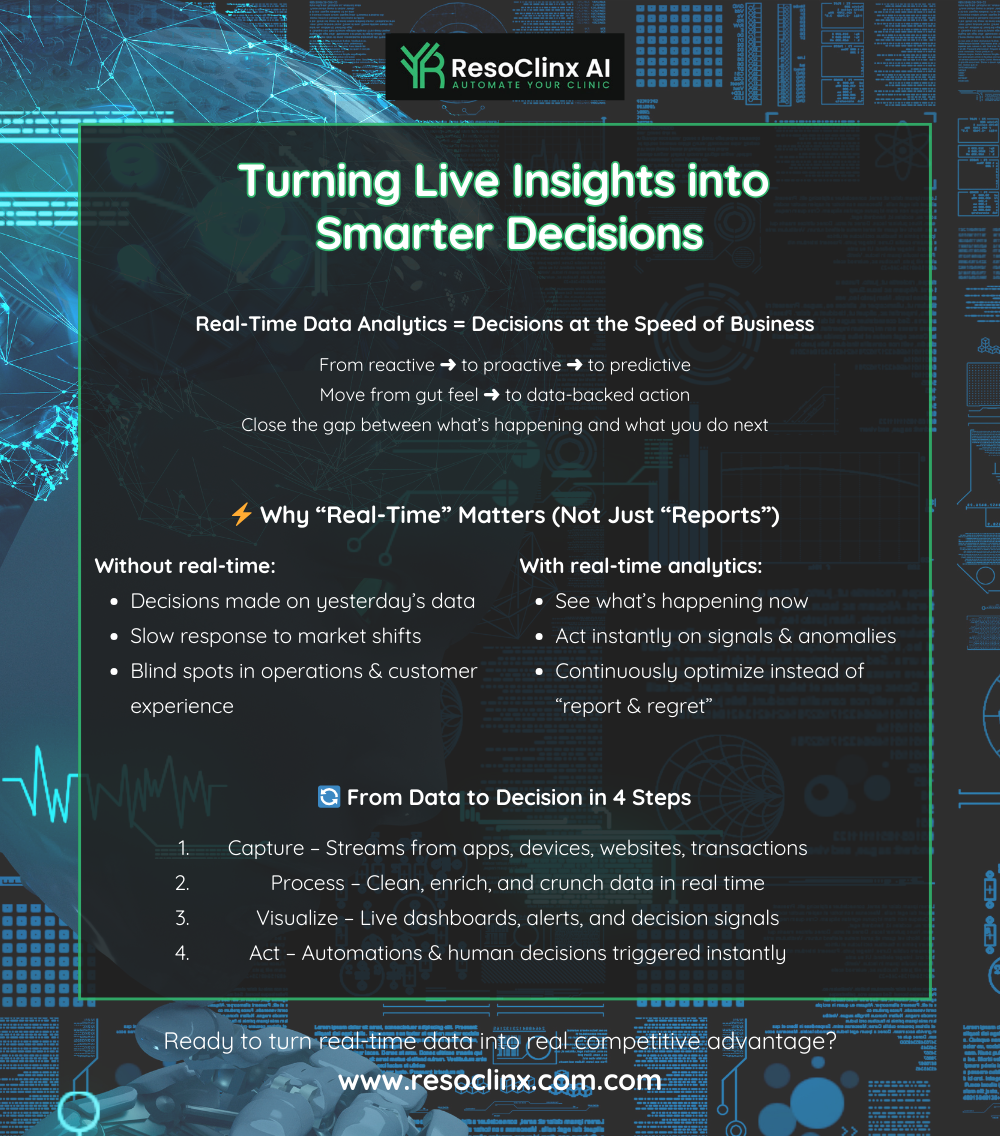
Understanding how your clinic is performing is essential for making informed, confident decisions. AI-powered analytics tools can process large volumes of data quickly, offering insights that might easily be missed with manual reporting.
With AI analytics, you can examine:
Treatment popularity: Which services are most in demand, and which could benefit from additional education or visibility.
Client acquisition and retention: How much it costs to acquire a new patient from each channel, and how often they typically return.
Revenue trends: Seasonal patterns or emerging opportunities in specific treatment categories.
Website and campaign performance: How visitors move through your site, which pages support conversions, and which campaigns generate the most qualified enquiries.
These insights allow you to allocate budget more carefully, refine your service offering and set realistic, data-led goals for growth rather than relying purely on intuition.
The Future of Marketing for Med Spas
The way patients discover, research and choose aesthetic providers is constantly evolving. Expectations around convenience, personalisation and transparency are higher than ever. AI sits at the centre of many of these changes, offering tools that help your clinic anticipate needs rather than simply react to them.
AI’s Role in Predictive Marketing
Marketing is not only about what is happening now; it is also about what comes next. AI can analyse historical data – such as booking patterns, treatment combinations and website interactions – to forecast what certain patient groups might be interested in.
For example, you may notice that patients who start with a particular skincare treatment often go on to explore specific advanced procedures. With AI-supported predictive marketing, you can:
Identify these patterns earlier.
Create educational campaigns that introduce suitable options at the right moment.
Plan service development and staffing decisions with more confidence.
Rather than relying on guesswork, you use evidence-based insights to guide where you focus your aesthetic clinic marketing.
Scalable Personalisation for Client Loyalty
Personalised experiences are a key driver of long-term loyalty. However, doing this manually for every patient quickly becomes unrealistic as your clinic grows. AI makes it possible to scale personalisation while still respecting professional and ethical boundaries.
By unifying data from your CRM, booking system and website, AI can support:
Tailored treatment reminders based on specific protocols or product lifecycles.
Relevant educational content aligned with someone’s concerns (e.g. skin quality, fine lines, pigmentation).
Individualised communication that reflects their stage of the patient journey, from initial enquiry to long-term maintenance.
Patients feel that your clinic understands their goals and preferences, rather than treating them as just another appointment slot. This leads to stronger relationships and makes it more likely that they will return and recommend you.
Adapting to Evolving Client Expectations
Patients today are more informed, more connected and often more discerning. They may research several providers, review clinical qualifications and scrutinise before-and-after images before making an enquiry. AI can help you keep pace with these evolving expectations.
By analysing feedback, reviews and engagement data, AI tools can highlight:
Which topics patients are most interested in, so you can create clearer educational content.
Where there may be gaps in your communication, such as unclear information about downtime or aftercare.
How preferences are shifting over time, for example towards less invasive treatments, combination therapies or specific skincare concerns.
Using these insights, you can adapt your messaging and service mix, ensuring you remain relevant and continue to provide a patient experience that feels current, responsive and clinically grounded.
Implementing AI for Marketing Success

Embracing AI does not mean transforming your entire clinic overnight. The most successful implementations are usually gradual, thoughtful and aligned with clear objectives. You do not need to be a technology expert to benefit from AI; you simply need to know what you want it to help you achieve.
Setting Clear Marketing Objectives
Before you explore any tools, take time to define your primary marketing goals. For example, you might want to:
Increase the number of qualified consultation requests each month.
Improve conversion rates from enquiry to booking.
Strengthen client retention and encourage appropriate maintenance visits.
Gain clearer insight into marketing performance across channels.
Once you are clear on your priorities, it becomes much easier to assess whether a given AI solution is relevant and worthwhile. A useful rule of thumb is to identify the problem first and then look for the tool, rather than starting with technology and trying to fit it into your workflow.
Selecting the Right AI Tools for Your Practice
With clear objectives in place, you can start to evaluate which AI tools may help your clinic. It is often sensible to begin in one or two areas, rather than trying to implement everything at once.
Common categories include:
Personalised communication tools: These help you send tailored messages, reminders and educational content based on patient data such as treatment history and interests.
Lead scoring and nurturing tools: These assess which enquiries are most engaged, helping your team prioritise follow-up.
Social media and content tools: These support planning, scheduling and basic content drafting for platforms like Instagram, Facebook and LinkedIn.
Advertising optimisation tools: These use AI – for example, within Google Ads – to adjust bids and placements in real time to improve return on ad spend.
Where possible, look for tools that are designed to work with healthcare or service-based businesses and that allow you to maintain control over clinical messaging and compliance. It is perfectly acceptable to start with modest, accessible tools and progress to more advanced options as your confidence grows.
Integrating AI with Existing Systems
For AI to be genuinely helpful, it should integrate smoothly with your existing systems, not sit in isolation. When evaluating options, consider:
Whether the tool connects to your CRM or practice management system, so you do not need to duplicate data.
How it handles patient privacy and data protection, including compliance with relevant UK regulations.
Whether it offers clear reporting, so you can see exactly what impact it is having.
Good integration means that AI becomes part of your normal workflow, rather than an extra task on top of everything else. Over time, this allows you to build a coherent, data-informed approach to aesthetic clinic marketing, rather than relying on disconnected systems.
Embrace the Future, Automatically
Integrating AI into your med spa’s marketing is not a distant ambition; it is a practical, achievable step that can improve how you attract, educate and retain patients. When smart tools handle much of the repetitive and data-heavy work, you gain more time to focus on what you do best: providing safe, effective treatments and building trust-based relationships.
Ultimately, AI is about working smarter rather than harder. By introducing it gradually, aligning it with clear goals and keeping your patients’ interests at the centre, you can build a marketing approach that is more consistent, more insightful and easier to manage – while maintaining the professional standards and ethics that underpin your clinic.