Getting your aesthetic clinic noticed online, especially on Google Maps, is essential for attracting new patients. People are constantly searching for aesthetic treatments in their local area, and if your clinic doesn’t appear where they’re looking, you’re likely losing enquiries to competitors.
This guide walks through practical Google Maps SEO for clinics so your practice appears more often in local results and makes it easier for patients nearby to find, understand, and trust your clinic.
Key Takeaways
Optimise your Google Business Profile (GBP). Keep details like your address, phone number, and opening times correct and up to date – it’s often the first thing people see when they search for clinics like yours.
Use local search phrases on your website. Terms such as “lip fillers in [your town]” or “aesthetic clinic in [your area]” help Google understand who you are, where you are, and support local SEO for clinics.
Encourage patient reviews on Google. Consistent, genuine reviews build social proof, strengthen your online reputation, and can help improve your local rankings.
Ensure your website is mobile-friendly and fast. A website that loads quickly and works well on phones keeps users engaged and reduces the chances of them leaving before they see what you offer.
Build links from trustworthy local websites. Quality backlinks from reputable local organisations, blogs, or directories signal to Google that your clinic is a real, reliable, and established business.
Optimising Your Google Business Profile For Local Visibility
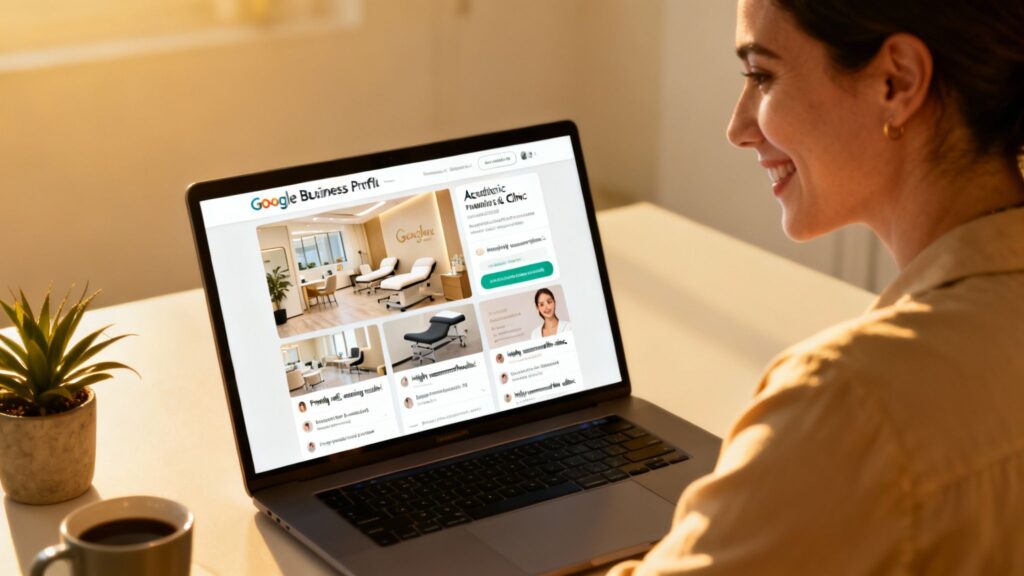
Think of your Google Business Profile (GBP) as your clinic’s digital front door. It is often the very first impression potential patients have, so making sure it’s accurate, inviting, and up to date is crucial.
This free tool from Google is one of the most effective ways to help local clients looking for aesthetic treatments discover your clinic. A profile that’s fully completed and regularly maintained makes it far easier for Google to match your clinic to local searches and can significantly increase how often people view and interact with your listing.
Establishing Your Clinic’s Digital Front Door
Your GBP is more than just a listing; it’s your clinic’s online identity. Patients use it to quickly find your name, address, phone number, opening hours, and website.
When someone searches for phrases like “aesthetic clinic near me” or “Botox in [your town]”, a well-optimised profile is what helps you appear. Completing your profile thoroughly makes it much easier for Google to understand what you offer and where you’re based. It’s the foundation for appearing in those all-important local search results and on Google Maps.
To strengthen this “digital front door”, make sure you:
Fill in every relevant field in GBP
Use a clear, accurate business name
Write a concise, informative business description focused on patient needs
Add your website URL and booking information where appropriate
Maintaining Accurate And Consistent Information
Keeping your Name, Address, and Phone number (NAP) consistent everywhere online is the bedrock of local SEO. It prevents both search engines and potential patients from getting confused.
Make sure your business name, address, and phone number are exactly the same on your:
Website
Google Business Profile
Social media profiles
Online directories and listings
Also:
Choose the most accurate categories available for your clinic – for example, “Medical spa”, “Skin care clinic”, or similar.
Clearly list your core services, such as “lip fillers”, “anti-wrinkle injections”, or “laser skin treatments”.
Regularly update your opening hours, especially for bank holidays, seasonal changes, or special events.
Consistent, accurate information tells Google your clinic is trustworthy, which directly supports higher visibility in local search results.
Leveraging High-Quality Visuals To Attract Clients
People are visual by nature, and photos make a substantial difference to how your clinic is perceived. Uploading professional images of your:
Clinic interior and exterior
Reception and waiting area
Treatment rooms
Team members
…helps create a welcoming and trustworthy first impression.
Where appropriate, and with explicit patient consent, you can also include before-and-after images that showcase realistic treatment outcomes. High-quality visuals help potential patients picture themselves in your clinic and give a tangible sense of the standards of care you provide.
Aim to refresh your photos periodically so your profile feels current and active rather than static or outdated.
Crafting Engaging Website Content With Local Keywords
To connect with people in your area who are looking for aesthetic treatments, you need to use the language they type into Google. This is where local keywords come in – those phrases that include both a treatment and a location.
For example, if someone in Leeds is looking for a skin treatment, they might search for:
“skin peels Headingley”
“dermal fillers near Roundhay”
By including these kinds of location-specific phrases on your website, you make it much easier for Google to show your clinic to the right local patients. This is a core part of aesthetic clinic marketing and effective local SEO for clinics.
Identifying High-Intent Local Search Terms
To find the local search phrases that matter most, put yourself in your potential patient’s shoes. Ask: “How would they look for this treatment?” Combine the services you offer with your town, city, or neighbourhood.
A simple way to brainstorm:
Service + Location:
“Botox Birmingham”
“Laser hair removal Manchester”
Service + Landmark/Area:
“Dermal fillers near the city centre”
“Facial treatments in the West End”
Problem + Location:
“Acne treatment Leeds”
“Scar removal Glasgow”
Don’t forget question-based searches. If you offer a specific treatment, create content that answers queries like:
“What is [treatment name]?”
“Is [treatment name] suitable for my skin type?”
Then naturally weave in your location, for example: “what to expect from microneedling in Manchester”. This positions your clinic as a local expert on that treatment.
Creating Location-Specific Service Pages
Instead of having one long “Services” page that lists everything, it’s far more effective to create individual pages for each treatment you offer, and – where relevant – tailor them to your locations.
For example, if you have multiple branches, you might have pages such as:
“Pico laser in Harley Street”
“Ultherapy in Manchester”
This approach brings two major benefits:
Better for Google: It helps search engines clearly understand which services you offer and where, making it easier to rank for location-based searches.
Better for patients: Visitors can quickly find specific information about a treatment in their area, without sifting through unrelated content.
Be sure to:
Link these service pages back to your homepage
Include a link to your Google Business Profile where appropriate
Add clear calls to action such as “Enquire now” or “Book a consultation” (in an informative, non-pushy tone)
This ties your services, website, and GBP together, helping Google connect your content directly to your clinic’s physical location.
Developing Authoritative Content For Patients
Authoritative, educational content builds trust and positions your clinic as a reliable source of information. Think about the questions people genuinely ask when they’re considering a treatment.
Useful content types include:
Treatment explainers & FAQs
Go into detail about what each procedure involves, who it’s suitable for, expected results, and typical recovery times. Address common concerns clearly and honestly.Comparison articles
If you offer similar treatments (for example, different types of facial rejuvenation or injectables), produce content comparing them so patients can understand which is most appropriate for their concerns.Location-focused blogs
Write posts such as “How to choose a clinic for [treatment] in [your town]” or “Why choosing a local clinic for your aesthetic needs matters”. These directly target local searches and position your clinic as a trusted local authority.
Producing content that genuinely helps patients understand their options and feel more confident in their decisions is key to attracting the right kind of client, rather than just more website visitors.
To make this manageable, try to create content in batches. Plan out three to five blog posts or page updates at a time, then schedule them to go live consistently over a month or quarter. This steady stream of helpful information shows Google that your clinic is active, relevant, and engaged.
Mastering Reviews: The Power Of Velocity And Consistency
Reviews are the modern equivalent of word of mouth, and for aesthetic clinics, they can strongly influence both local visibility and patient trust. It’s not just about collecting lots of five-star ratings; it’s about building a consistent flow of genuine, balanced feedback.
Google pays attention to:
How often you receive reviews
The quality and detail of those reviews
How you respond to them
Together, this activity signals that your clinic is a reputable, well-run practice.
Encouraging Patient Feedback
Most satisfied patients are happy to leave a review, but they may need a gentle nudge and a simple process.
The best time to ask is usually soon after a successful treatment, when they’re pleased with the experience and results.
A simple approach:
Timing is key: Ask when a patient expresses satisfaction or thanks your team.
Make it simple: Provide a direct review link or QR code that leads straight to your Google Business Profile.
Explain the “why”: Briefly mention how their feedback helps others make informed decisions and supports your clinic in continuing to improve.
By making the process quick and effortless, you dramatically increase the likelihood that patients will leave a review.
Responding To All Reviews
Every review, whether it’s glowing or critical, is an opportunity to demonstrate your professionalism and patient focus.
For positive reviews:
Offer a genuine thank you
Acknowledge any specific aspects they mention (for example, a particular staff member or treatment)
For negative or mixed feedback:
Respond calmly and courteously
Acknowledge their experience
Where appropriate, apologise and invite them to discuss their concerns privately (for example by phone or email)
It’s not about winning an argument; it’s about showing that you are a responsible clinic owner who listens and takes feedback seriously. This level of responsiveness reassures prospective patients who are comparing providers.
Leveraging Reviews For Local Ranking
Google notices when businesses are actively engaging with their patients. Receiving a steady flow of new reviews – even just one or two regularly – signals that your clinic is active and valued.
Where possible, encourage patients (without scripting them) to:
Mention the specific treatment they received
Refer to your clinic name and location, for example:
“Had a fantastic facial at [Clinic Name] in [Town]”
These small details help Google understand what you do and where you do it.
Responding to reviews also acts as an engagement signal, showing that your clinic is present and involved. Don’t forget to showcase selected reviews on important pages of your website; genuine patient feedback builds trust far more effectively than marketing copy and supports your wider aesthetic clinic marketing activity.
Building Authority Signals For Enhanced Visibility

Press Releases And Backlinks As Authority Boosters
Think of authority signals as your clinic’s reputation across the internet. Google considers these signals when deciding where to rank your clinic on Maps and in local search.
Two highly effective authority signals are:
Press releases
These are excellent for announcing new services, new clinicians, or new locations. Sending press releases to local news outlets, relevant industry blogs, or community platforms can increase awareness of your clinic. Always include a link back to the most relevant page on your website (for example, the specific service or location page), so you direct both traffic and authority to the right place.Quality backlinks
Backlinks are links from other websites to yours, and they act like votes of confidence. When reputable local blogs, beauty sites, or community organisations link to your clinic’s website, it signals that your clinic is a credible, established provider. Links that point to specific service or location pages are especially powerful, as they reinforce the relevance of those pages for particular treatments and areas.
Together, these activities help position your clinic as an important part of the local healthcare and aesthetics landscape.
Understanding Internal Linking Strategies
Internal linking is about how the pages within your own website connect to each other. Think of it as creating a clear roadmap for both visitors and search engines.
Good internal linking helps:
Google discover and index key pages (like service and location pages)
Patients move smoothly from informational content (blogs) to actionable content (service pages or contact forms)
Practical ways to use internal links:
From your homepage and main navigation, link clearly to your core treatments and, where relevant, your location pages.
From blog posts, link to related services (for example, a blog about acne scarring linking to your microneedling or laser resurfacing pages).
Include internal links in FAQs and treatment explainers to guide patients to more detailed information.
It’s also a good practice to link from your service pages to authoritative, trustworthy sources, where relevant. For example, you might link to the NHS, recognised professional bodies, or well-respected medical journals. This doesn’t promote those organisations; instead, it shows Google and your readers that your information is grounded in reliable, evidence-based data, which can strengthen your clinic’s perceived credibility.
Focusing On The User Journey
Ultimately, every SEO tactic should be in service of a better patient experience. When someone searches for an aesthetic clinic on Google Maps, they’re looking for clear, reassuring information and a clinic they can trust.
Consider the full journey:
Search: A patient types “lip fillers near me” or “skin clinic [town]”.
Discovery: They see your Google Business Profile with accurate information, strong reviews, and helpful photos.
Exploration: They click through to your website and find clear service pages, localised content, and straightforward next steps.
Decision: They feel confident enough to enquire or book.
Make sure:
Your website is easy to navigate on both desktop and mobile
Service pages are clear, informative, and realistic
Your GBP is complete, current, and visually appealing
Contact and booking information is obvious and simple to use
Here’s a quick look at how these elements work together:
Press releases: Announce new services or locations and drive local awareness.
Quality backlinks: Signal credibility and trust from external, relevant websites.
Internal linking: Helps Google discover and index key pages and guides users to the right information.
Outbound links: Demonstrate reliance on credible information and reinforce trust.
User experience: Keeps visitors engaged, reduces bounce rates, and signals relevance to Google.
A smooth user journey not only helps with search rankings but also increases the likelihood that visitors turn into happy, long-term patients.
Here’s a quick look at how these elements work together:
Authority Signal Type | How It Helps Visibility |
|---|---|
Press Releases | Announces new services/locations, drives local awareness. |
Quality Backlinks | Signals credibility and trust from external sources. |
Internal Linking | Helps Google discover and index pages, guides users. |
Outbound Links | Demonstrates reliance on credible information, builds trust. |
User Experience | Keeps visitors engaged, reduces bounce rates, signals relevance. |
Understanding Google Maps Ranking Factors
Once your clinic and website are looking their best, the next question is: how does Google decide who appears at the top of Maps results? It’s not random. Google relies on a set of main factors to determine which clinics are the most relevant and trustworthy for a given search.
Three key factors are:
Relevance
Distance
Prominence
Understanding these helps you shape a local SEO strategy that aligns with how Google actually works.
Relevance: Matching Searcher Intent
Relevance is about how closely your clinic’s profile and website content match what someone is searching for. If someone looks for “laser hair removal near me”, Google will look for clinics that clearly offer laser hair removal, not just generic “beauty treatments”.
To improve relevance:
Make sure your GBP lists your main services specifically
Use the same treatment names on your website and GBP
Include local keywords in your titles, headings, and content where they fit naturally
If you offer advanced skincare treatments, make that crystal clear in your Google Business Profile description and on your service pages. The clearer and more specific you are, the easier it is for Google to match you to the right searches.
Distance: Proximity to the Searcher
Distance is straightforward: Google generally prefers to show clinics that are physically closer to the person searching.
If someone in Manchester searches for a clinic, Google will usually display clinics in or near Manchester before showing options in London. You can’t change your clinic’s location, but understanding this factor explains why local visibility matters so much.
When someone is searching from further afield, other factors, such as relevance and prominence, become more important if you want them to consider travelling to your clinic.
Prominence: Establishing Your Clinic’s Reputation
Prominence is Google’s way of estimating how well-known and trusted your clinic is, both online and offline. It considers signals such as:
Reviews: The number, quality, and recency of reviews on your GBP.
Citations: Consistent mentions of your clinic’s name, address, and phone number on reputable directories and websites.
Backlinks: Links from relevant, trustworthy websites to your clinic’s site.
Website authority: How strong, well-optimised, and user-friendly your own website is.
Google looks at the broader picture to gauge your clinic’s standing in the local community and the wider industry. The more established and trusted you appear, the more likely you are to rank prominently on Google Maps.
Advanced Local SEO Tactics For Aesthetic Clinics

Once the foundations are in place, you can add more advanced tactics to give your clinic an extra edge in local search and Google Maps visibility.
These include:
Implementing structured data (schema)
Maintaining consistent GBP posts
Embedding Google reviews on your website
Each of these helps Google to better understand your clinic and gives patients a richer experience when they find you.
Utilising Appointment Schema For Bookings
Think of schema markup as a special code that helps search engines interpret your content more accurately. For aesthetic clinics, adding structured data such as LocalBusiness and appointment-related schema is a smart move.
Benefits include:
Helping Google recognise that your clinic offers appointments
Making your pages eligible for richer local results in Search
Supporting a smoother booking journey when combined with approved booking tools or integrations
In some cases, when your website and GBP are connected to approved booking partners or Google’s own booking integrations, patients may see options to book directly from Search or Maps. Structured data doesn’t guarantee this on its own, but it helps Google understand your site in a way that supports these experiences.
Consistent Google Business Profile Posting
Your Google Business Profile is not just a static listing; it can work like a mini-blog for your clinic.
Regular posts can include:
Updates about new treatments or technologies
Educational content (for example, explaining the difference between two procedures)
Important clinic news, such as changes to opening hours
Carefully worded behind-the-scenes glimpses of your team and environment
Posting consistently signals to Google that your clinic is active and relevant, which supports your visibility in local search.
Aim to post at least once a week to keep your profile fresh and informative, rather than letting it sit untouched for months.
Embedding Google Reviews On Your Website
Social proof is incredibly powerful in aesthetics. Embedding your Google reviews directly on your website adds an extra layer of trust and transparency.
Advantages include:
Visitors see genuine feedback from real patients without leaving your site.
Your pages stay fresh, as reviews update over time.
The language patients use in reviews can naturally incorporate relevant keywords, supporting your SEO.
Consider featuring reviews on:
Your homepage
Key service pages (for example, a testimonial from an injectables patient on your dermal fillers page)
A dedicated “Patient Reviews” or “Testimonials” page
This approach reinforces your clinic’s reputation and reliability at every step of the user journey.
Monitoring Competitors And Refining Your Strategy
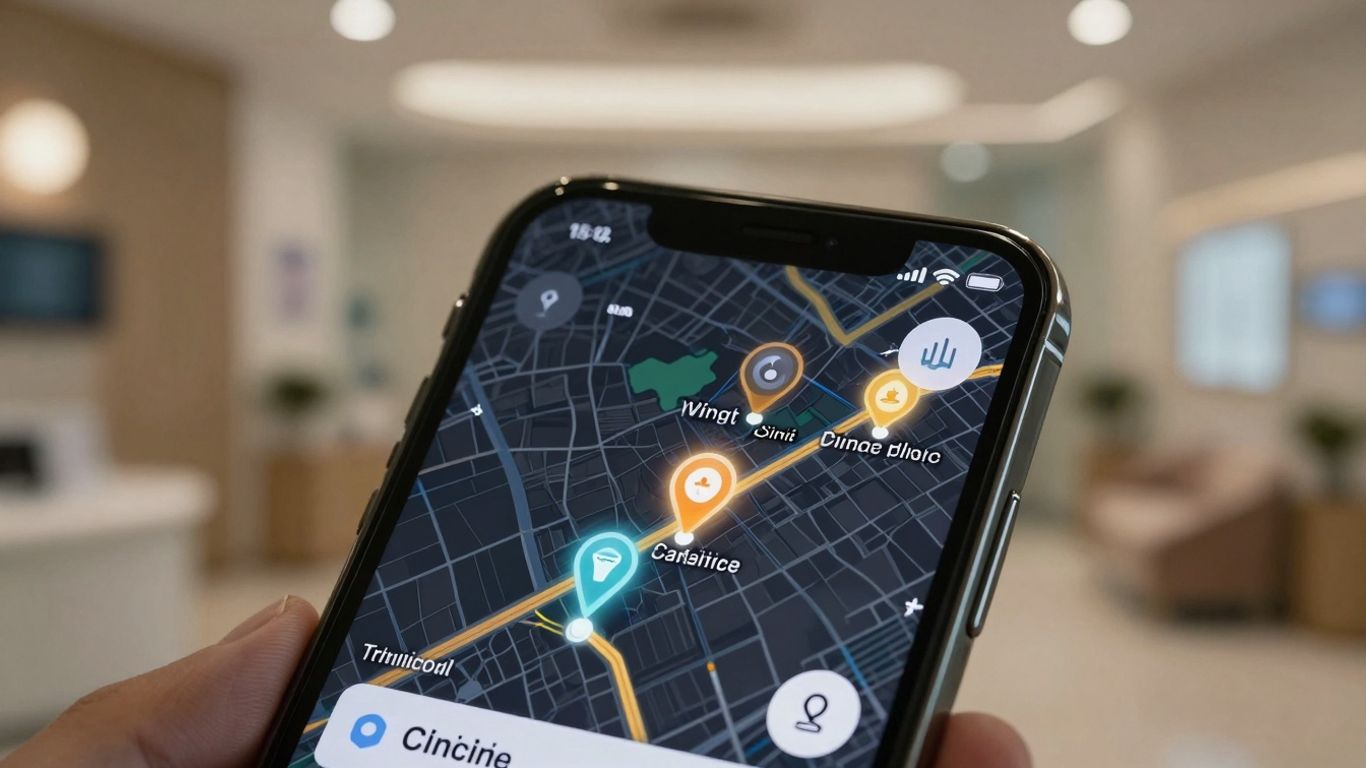
It’s easy to focus entirely on optimising your own clinic, but the clinics that appear alongside you on Google Maps are competing for the same patients. Monitoring their activity helps you understand the local search landscape and identify opportunities to differentiate your clinic.
You don’t need to copy anyone, but by observing what others are doing, you can refine your own content, GBP activity, and authority building.
Tracking Competitor Keyword Rankings
Your competitors are likely ranking for specific keywords that you may not yet be targeting. By identifying these, you can uncover content gaps and new opportunities.
A practical process:
Identify top competitors
List 3–5 clinics that appear prominently in local results for your core services.Conduct keyword research
Use specialist SEO tools to see which search terms are driving traffic to their sites.Perform a content gap analysis
Check whether their pages answer patient questions or highlight services that your site doesn’t currently cover.Adapt and improve
Create new content or optimise existing pages to address these topics in your own words and style, aligned with your clinic’s values and clinical standards.
This ensures you’re part of the online conversation patients are already having about treatments in your area.
Analysing Google Business Activity
Your Google Business Profile is central to local visibility, and your competitors are likely using it actively too.
Look at:
Review volume and sentiment – How many new reviews do they receive, and what’s the general tone?
GBP posts – How often do they post? What themes do they focus on (education, new treatments, events)?
Photos and videos – Are they regularly updating visuals, and what aspects of the clinic are they showcasing?
Q&A section – Are they proactively answering common questions about treatments, pricing, or aftercare?
Understanding how others are using GBP helps you spot missed opportunities in your own profile, such as unanswered questions, outdated photos, or the absence of regular, educational posts.
Adapting To New Content And Backlinks
The online landscape is constantly evolving. Competitors may publish new blog posts on emerging treatment trends, create in-depth guides, or be featured in local press or industry publications.
When you notice new content from a competitor, ask:
What topic are they covering?
Does it relate to services we also provide?
Are they answering a question we haven’t addressed yet?
Have they gained backlinks from reputable sites as a result?
Use this insight to guide your own content strategy. You can:
Develop more comprehensive or better-structured resources
Approach similar topics with a patient-first, balanced tone
Seek your own relevant coverage and partnerships
This ongoing refinement ensures your clinic stays visible, informative, and competitive in local search.
Bringing It All Together for Clinic Success
We’ve covered a lot of ground, from optimising your Google Business Profile to building reviews, content, and authority signals that support stronger visibility on Google Maps.
Individually, these actions may feel small, but together they form the foundation of effective Google Maps SEO for clinics. Treat them as ongoing habits, not one-off tasks:
Keep your details accurate and consistent
Publish helpful, localised content regularly
Encourage genuine patient reviews and respond thoughtfully
Build relevant links and citations
Monitor how your competitors show up in local search
Over time, this consistent, patient-focused approach makes it easier for people in your area to:
Find your clinic
Understand your services
Feel confident choosing you for their aesthetic treatments
The goal is not to “sell” hard, but to provide clear, trustworthy information that supports patients in making the right decisions for themselves.