

Running a clinic often feels like a constant juggling act — balancing patient needs, clinician availability, and the ongoing challenge of missed appointments. When scheduling goes wrong, it can disrupt your clinic’s efficiency and affect revenue.
But there’s a smarter, more reliable approach. AI scheduling for clinics helps streamline appointment management, reduce no-shows, and keep your calendar consistently full.
Key Takeaways
- AI scheduling systems are transforming aesthetic clinic marketing by reducing no-shows, improving patient experience, and freeing up staff time.
- AI scheduling for clinics helps sort out the mess of traditional appointment booking, which often leads to missed slots and frustrated patients.
- By using smart reminders and automatically filling gaps from cancellations, AI can significantly cut down on no-shows and make sure your clinic’s calendar is used to its full potential.
- Patients get a better experience with easy, 24/7 booking options, reducing stress and making it simpler for them to get the care they need.
- Clinic staff can spend less time on admin tasks like phone calls and manual updates, freeing them up to focus on patient care and other important jobs.
- Integrating AI scheduling with existing clinic systems, like EMRs, means everything stays up-to-date and secure, while also providing useful data to make better decisions.
Streamlining Clinic Operations with AI Scheduling
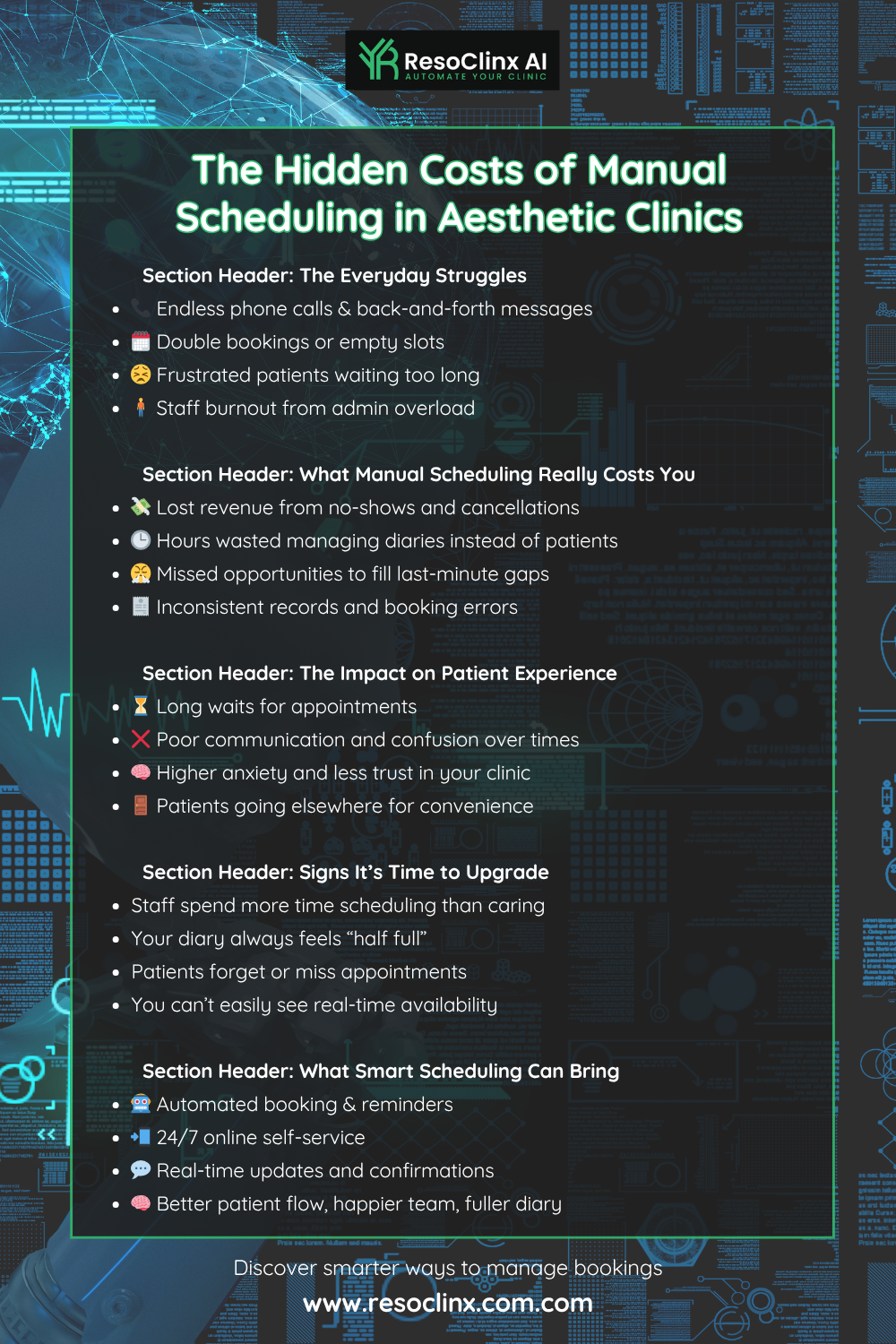
Clinic operations involve many moving parts, and appointment scheduling is often one of the biggest challenges. Many practices still rely on manual systems or basic booking software, which can lead to double bookings, missed slots, and frustrated patients. a
These outdated processes simply can’t keep pace with the demands of modern healthcare.
Understanding the Challenges of Traditional Scheduling
Traditional scheduling methods, whether it’s a wall calendar, a spreadsheet, or even a basic digital diary, are prone to human error. They require constant manual input, making them time-consuming and inefficient.
Think about the sheer volume of calls a busy clinic receives daily just to book, reschedule, or cancel appointments. This takes valuable time away from staff who could be focusing on patient care or other critical administrative tasks.
AI scheduling systems go far beyond basic calendar management. They learn from patterns, predict potential scheduling conflicts, and automate many time-consuming administrative tasks.
The Impact of Inefficiencies on Clinics and Patients
The ripple effect of inefficient scheduling is significant. For clinics, it means lost revenue due to missed appointments and underutilised clinician time. It can also lead to increased staff burnout as they struggle to keep up with the administrative load.
For patients, the experience can be just as negative. Long phone wait times, difficulty finding convenient appointment slots, and the anxiety of forgetting an appointment all contribute to a less-than-ideal healthcare journey. This friction can even impact patient loyalty and the clinic’s reputation.
Introducing AI Scheduling as a Transformative Solution
This is where Artificial Intelligence (AI) scheduling steps in, offering a smarter, more automated way to manage appointments. AI scheduling is not just about filling slots; it’s about optimising the entire patient flow and operational efficiency of a clinic.
By taking over the complexities of scheduling, AI frees up both staff and patients, leading to a smoother, more effective healthcare experience for everyone involved. It’s a move towards a more intelligent and patient-centred approach to clinic operations.
Reducing No-Shows and Maximising Calendar Utilisation
Missed appointments are a real drain on clinic resources, not to mention the disruption to patient care. It’s a problem that affects profitability and can lead to longer waiting times for everyone. But there are smart ways to tackle this.
The Costly Problem of Missed Appointments
No-shows and last-minute cancellations aren’t just an inconvenience; they represent a significant financial hit for clinics. When a slot is empty, the revenue that could have been generated is lost.
For smaller practices, even a few missed appointments a day can really impact the bottom line. Beyond the direct financial loss, there’s the wasted time of staff and providers, and the frustration for patients who might have been able to use that slot.
- Financial Impact: Each missed appointment can cost hundreds of pounds in lost revenue.
- Operational Inefficiency: Wasted staff time and provider availability.
- Patient Dissatisfaction: Delays and longer waits for others.
The hidden costs of inefficient scheduling are staggering. In the UK, missed appointments are estimated to cost the NHS hundreds of millions of pounds each year, highlighting how serious the issue is for both public and private healthcare providers. For individual practices, this translates to thousands, if not tens of thousands, of pounds lost each year. It’s a problem that demands a proactive solution.
Intelligent Reminders and Confirmation Strategies
One of the most effective Google Business Profile tips for clinics is to ensure contact information and reminders are consistent across all systems — and AI scheduling tools help automate that process. Automated reminder systems can make a huge difference.
These systems can be configured to send out appointment confirmations shortly after booking, followed by polite reminders closer to the date. The key is to make it easy for patients to confirm their attendance or, if necessary, to cancel or reschedule with ample notice.
- Automated Confirmations: Sent immediately after booking to secure commitment.
- Personalised Reminders: Delivered via SMS or email a day or two before the appointment.
- Easy Rescheduling Options: Providing a direct link or number to change appointments, reducing the likelihood of a complete no-show.
Proactive Gap-Filling with Waitlist Automation
Even with the best reminder systems, cancellations will happen. This is where waitlist automation shines. When an appointment is cancelled, the system can automatically notify patients who are on a waitlist for a similar time or service. This allows clinics to fill those newly opened slots quickly, minimising lost revenue and ensuring the schedule remains as full as possible. It turns a potential problem into an opportunity to serve more patients.
- Real-time Notifications: Alerting patients on the waitlist instantly.
- Prioritised Filling: Offering slots to patients based on their stated preferences or urgency.
- Reduced Downtime: Keeping provider schedules consistently occupied.
Enhancing Patient Experience Through Seamless Booking

In today’s fast-paced world, patients expect convenience and ease when managing their healthcare appointments. Patients no longer expect to be restricted by opening hours or long phone queues.
Modern AI scheduling systems transform this by putting the patient in control, making the booking process smoother and more pleasant. This improvement directly supports local SEO for clinics, as online booking availability is a key factor in search visibility.
Empowering Patients with 24/7 Self-Service Booking
One of the most significant advantages of AI-powered scheduling is the ability for patients to book appointments whenever and wherever suits them. Whether it’s late at night, during a lunch break, or on a weekend, your clinic’s schedule is accessible.
This 24/7 availability means patients can secure appointments at their convenience, reducing the likelihood of them seeking care elsewhere due to scheduling difficulties. It’s about meeting patients where they are, making your services more accessible than ever before.
Reducing Patient Anxiety with Clear Communication
Healthcare appointments can sometimes be a source of anxiety for patients. AI scheduling helps alleviate this by providing clear, consistent communication. From the moment a patient books an appointment, they receive immediate confirmation, details about the appointment, and any necessary preparation instructions.
Automated reminders, sent via their preferred communication channel, help them remember their appointment, reducing the chance of missed visits. This clarity and proactive communication build trust and make the patient feel more informed and at ease throughout their healthcare journey.
Personalised Scheduling for Individual Needs
AI scheduling goes beyond simply filling slots; it can tailor the booking experience to individual patient needs. The system can consider factors such as appointment type, required duration, and even patient preferences when suggesting available times.
This intelligent matching ensures that patients are booked with the most appropriate provider for their specific needs and that the appointment duration is accurately accounted for, preventing rushed appointments or unnecessary gaps. This personalised approach demonstrates a commitment to individual care and improves overall patient satisfaction.
Boosting Provider Efficiency and Staff Productivity

Day-to-day clinic management often involves numerous calls, paperwork, and constant coordination — all of which consume valuable time. AI scheduling systems help reduce that administrative load, allowing your team to focus more on patient care and less on logistics.
Optimising Provider Schedules for Peak Performance
Think about how provider schedules often look now – sometimes packed to the brim, other times with awkward gaps. This isn’t just inefficient; it can lead to provider burnout and missed opportunities to see patients. AI scheduling looks at your clinic’s patterns and provider availability to create a much smoother flow. It can intelligently distribute appointments throughout the day, avoiding those dreaded patient rushes and quiet lulls.
This means providers can work more consistently, reducing stress and making their time more predictable. It’s about making sure every minute counts, not just for the clinic’s bottom line, but for the well-being of your medical staff too.
Automating Manual Tasks for Administrative Staff
Let’s be honest, administrative tasks like booking appointments, sending reminders, and managing cancellations can be a real drain on your reception and admin teams. AI scheduling takes over many of these repetitive jobs.
Instead of spending hours on the phone or manually updating calendars, your staff can focus on more important things, like greeting patients warmly or handling more complex queries. This automation doesn’t just save time; it reduces errors and ensures a consistent experience for everyone. Imagine your front desk team having more time to actually connect with patients, rather than just managing a diary.
Minimising Interruptions and Fostering Focus on Care
Constant interruptions can really break a provider’s concentration, which isn’t ideal when you’re focused on patient care. AI scheduling helps by managing the appointment flow more effectively.
appointments are booked and managed intelligently, there are fewer last-minute changes or urgent requests that disrupt a consultation. This allows doctors and nurses to stay in their flow, providing more focused and higher-quality care. It creates a calmer environment for both the patient and the practitioner, which ultimately leads to better health outcomes.
Here’s a look at how AI scheduling can free up your team:
- Reduced time spent on manual booking: AI handles online bookings and phone inquiries more efficiently.
- Fewer no-shows and last-minute cancellations: Automated reminders and confirmations keep schedules full.
- Streamlined rescheduling: Patients can often manage their own changes, reducing staff workload.
- Automated follow-ups: Post-appointment surveys or follow-up reminders can be handled automatically.
By taking on the burden of routine scheduling tasks, AI allows your human staff to dedicate their energy to the aspects of healthcare that truly require a personal touch. This shift not only boosts productivity but also improves job satisfaction for your team.
Integrating AI Scheduling with Existing Clinic Systems
Bringing AI scheduling into your clinic isn’t about replacing what you have; it’s about making it work better together. The goal is to connect the smart scheduling system with your current tools, like your Electronic Medical Records (EMR) or Electronic Health Records (EHR), so everything flows smoothly.
This integration means your patient data is always up-to-date across all systems, reducing errors and saving your staff time. Think of it as giving your clinic a central nervous system for appointments.
Seamless EMR and EHR Integration for Data Sync
Connecting your AI scheduling tool with your EMR/EHR system is a big step. It allows for a two-way flow of information. When a new patient books an appointment through the AI, their details can be automatically added to your EMR.
Likewise, if a doctor updates a patient’s record or adds notes, this information can be reflected in the scheduling system, helping the AI make smarter decisions about appointment types and durations. This sync stops you from having to enter the same information multiple times, which is a huge time-saver and cuts down on mistakes.
Ensuring Compliance and Data Security
When dealing with patient information, security and following regulations are non-negotiable. Any AI scheduling system you consider must be built with data protection in mind. This means it should comply with regulations such as the UK GDPR and the Data Protection Act 2018, ensuring patient information remains secure and confidential.
The system needs to protect sensitive patient data from unauthorised access and ensure that all communications and data storage are secure. It’s about building trust with your patients by showing you take their privacy seriously.
Leveraging Advanced Analytics for Informed Decisions
Once your AI scheduling system is up and running and integrated with your other tools, it starts collecting a lot of useful data. This data can tell you a great deal about how your clinic operates. You can see patterns in appointment no-shows, understand which times of day are busiest, or even identify which services are most popular.
This information is gold for making better decisions about staffing, resource allocation, and even service offerings. It moves you from guessing to knowing, allowing for more strategic planning.
Here’s a look at what kind of insights you might gain:
- Appointment Trends: Identify peak booking times and days.
- No-Show Rates: Pinpoint specific appointment types or patient demographics with higher no-show percentages.
- Provider Utilisation: See how effectively each provider’s schedule is being used.
- Patient Flow: Understand how long patients typically wait and how long appointments last.
The real power of AI scheduling comes not just from automating tasks, but from the intelligence it gathers. This intelligence, when properly integrated and analysed, can transform how a clinic operates, leading to significant improvements in efficiency and patient care.
The Future of AI Scheduling in Healthcare
It’s clear that AI scheduling isn’t just a passing trend; it’s rapidly becoming a core part of how clinics operate. As we look ahead, the capabilities of AI in this area are set to expand even further, moving beyond simple appointment booking to become a more integrated and intelligent part of patient care.
Emerging AI Capabilities for Advanced Automation
The next wave of AI scheduling will bring more sophisticated automation. Think about AI that can proactively identify potential scheduling conflicts before they even arise, or systems that can automatically adjust schedules based on real-time changes like a doctor’s unexpected absence.
We’re moving towards AI that doesn’t just fill slots, but actively manages the flow of patients and resources with a level of foresight that’s currently impossible with manual systems.
- Predictive Scheduling: AI will analyse historical data to predict patient no-show patterns and busy periods, suggesting optimal appointment times to maximise attendance. For instance, it might learn that a particular patient tends to miss early morning appointments and suggest an afternoon slot instead.
- Multimodal Interactions: Scheduling interfaces will become more natural, allowing patients to interact via voice commands, visual selections on a screen, or even by uploading documents like referral notes. This makes the process more accessible for everyone.
- Agentic AI: This advanced form of AI can act autonomously to achieve goals. In scheduling, it means an AI agent could handle complex rescheduling after a cancellation, coordinate appointments across multiple specialists, and communicate updates to patients without human intervention.
The true power of future AI scheduling lies in its ability to act as an intelligent coordinator, anticipating needs and orchestrating complex logistical challenges with minimal human input. This shift transforms scheduling from a reactive administrative task into a proactive element of care delivery.
The Role of AI in Value-Based Care
In a healthcare system increasingly focused on value and outcomes, AI scheduling plays a significant role. By reducing no-shows and optimising appointment flow, AI helps clinics operate more efficiently, which can lead to better resource allocation and potentially lower costs.
This efficiency directly supports the goals of value-based care by ensuring patients receive timely access to the services they need, improving overall health outcomes.
Choosing the Right AI Scheduling Partner
Selecting the right technology partner is crucial to ensure your AI scheduling system truly enhances your operations rather than complicating them.
As you consider adopting AI for your clinic’s scheduling, selecting the right partner is key. Look for a solution that offers:
- Seamless Integration: The system should connect easily with your existing Electronic Health Records (EHR) and other clinic management software.
- Customisation: It needs to be adaptable to your clinic’s specific workflows, appointment types, and provider preferences.
- Robust Support: A good partner will provide ongoing technical support and guidance to help you get the most out of the AI system.
- Clear ROI: Understand how the AI solution will measure success, whether through reduced no-shows, increased appointment volume, or improved staff productivity.
Smarter Scheduling for a Fuller Practice
AI scheduling for clinics is no longer a futuristic concept — it’s a practical solution already improving efficiency, patient experience, and staff productivity. By reducing no-shows, automating reminders, and intelligently managing cancellations, clinics can optimise their time and resources.
The result is smoother operations, happier patients, and a consistently full calendar. Embracing AI scheduling is a strategic step towards a more efficient, patient-centred, and successful practice.