

Introducing an AI receptionist to your aesthetic clinic can be a practical way to streamline operations, reduce administrative workload, and improve patient communication. But how much does an AI receptionist actually cost, and what determines the price?
This guide breaks down the key factors, what you can expect from different pricing models, and how to assess whether this technology is a worthwhile investment for your clinic.
Key Takeaways
- AI receptionists are generally more cost-effective than employing a full-time human receptionist, particularly when considering 24/7 availability.
- Automation of appointment booking and routine communication significantly reduces administrative workload.
- AI systems can handle high volumes of enquiries instantly, helping minimise missed calls and potential lost bookings.
- Integrating AI with your clinic’s existing management system creates smoother workflows and reduces manual data entry.
- Long-term value comes from improved efficiency, fewer missed appointments, and higher patient retention.
Understanding the AI Receptionist Cost Landscape
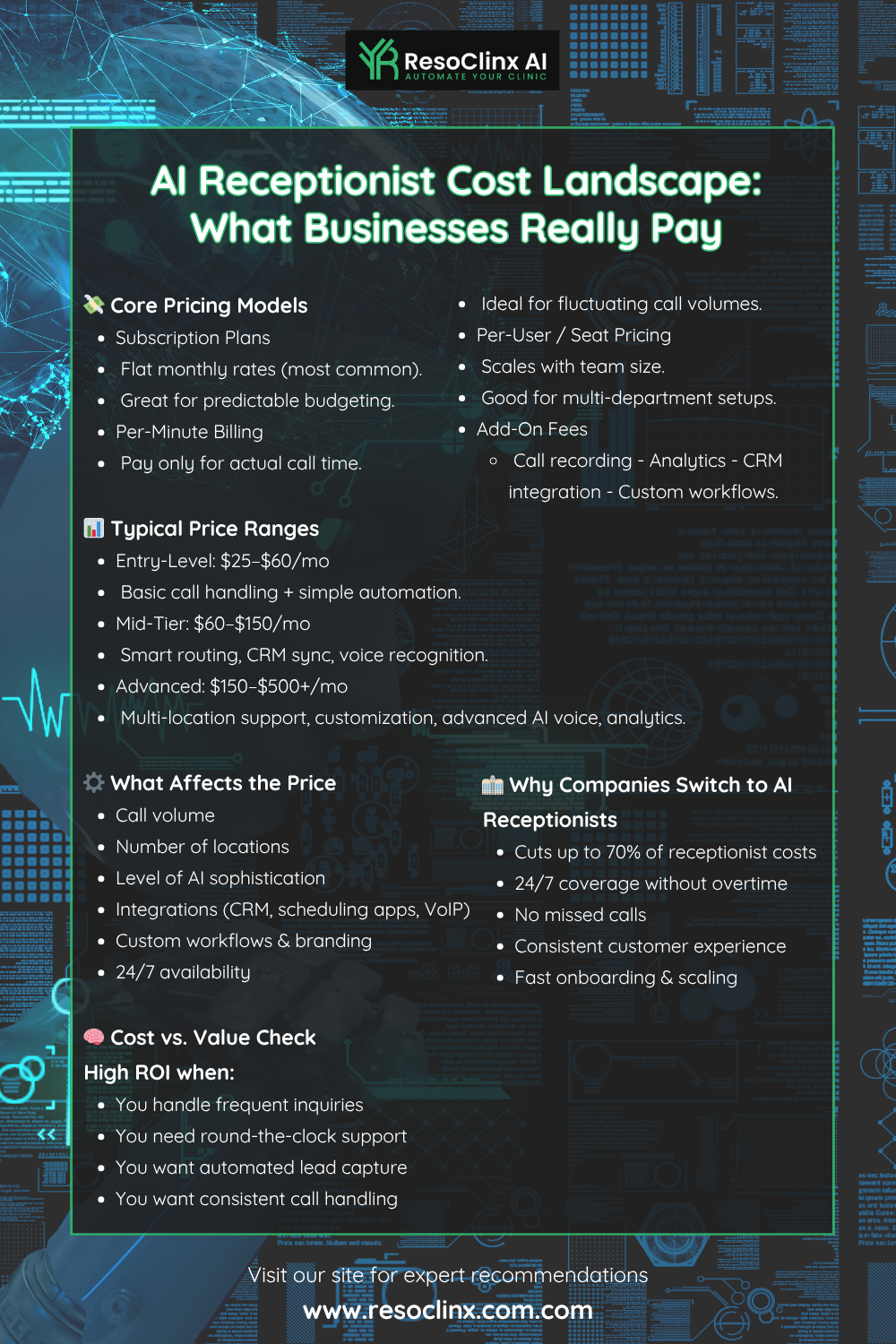
The cost of an AI receptionist varies depending on the level of functionality you require. Instead of a single fixed fee, most providers offer several pricing tiers shaped by the features, level of automation, and integration your clinic needs.
Factors Influencing AI Receptionist Pricing
Several elements affect the overall cost:
- Feature Set: Basic tasks such as call answering cost less, while advanced features—such as intelligent FAQs, real-time scheduling, or intake questions—increase pricing.
- Usage Volume: Some providers charge based on the number of calls, messages, or minutes processed.
- Integration Requirements: Connecting the AI to your clinic management software or CRM may add implementation costs.
- Customisation: Tailored responses, workflows, or branding typically increase pricing.
- Support Level: Higher-tier plans usually include faster support or dedicated assistance.
Comparing Subscription Models
Most AI receptionist platforms offer one of the following:
- Tiered Plans: Fixed monthly plans with predefined features. Lower tiers typically include basic communication, while higher tiers offer advanced scheduling and integrations.
- Usage-Based Pricing: Costs are based on interaction volume—ideal if your clinic experiences seasonal or unpredictable activity.
- Hybrid Models: A combination of a base monthly fee plus additional charges for usage or premium add-ons.
When comparing providers, always check what is included in each plan. A lower price may come with limitations that become costly to upgrade later.
The Value Proposition Beyond Initial Cost
The true benefit of an AI receptionist extends beyond the subscription fee. By reducing repetitive administrative tasks and providing 24/7 availability, AI can significantly improve your clinic’s efficiency and accessibility.
Freeing staff from routine phone calls allows them to focus on in-clinic responsibilities, patient care, and more complex enquiries. This can lead to better patient experiences and fewer missed opportunities—both of which contribute to increased revenue over time.
When considering the cost, it’s helpful to think about the potential savings. Reducing administrative overhead, minimising missed appointments, and improving staff focus all contribute to a stronger bottom line. The AI receptionist pays for itself not just in direct cost savings but in the increased capacity and improved patient satisfaction it brings.
Core Features and Their Impact on AI Receptionist Cost

The value of an AI receptionist is closely tied to its capabilities. As functionality increases, so does the potential impact on your clinic’s efficiency.
Essential Communication Capabilities
Most AI receptionists can:
- Answer phone calls
- Provide opening hours and basic information
- Respond to common questions
More advanced systems offer natural-sounding dialogue and stronger understanding of patient queries, resulting in smoother interactions.
Advanced Booking and Scheduling Functions
Higher-tier systems can:
- Check appointment availability in real time
- Book, reschedule, and cancel appointments
- Send automated confirmations and reminders
This round-the-clock booking ability helps clinics capture appointments outside standard working hours.
Integration with Clinic Management Systems
Integration is often the most valuable feature. When connected to your PMS or CRM, AI can:
- Update patient records
- Collect pre-appointment information
- Reduce duplicated data entry
Integrated systems offer the greatest long-term efficiency and cost savings.
| Feature Category | Basic Functionality | Advanced Functionality |
|---|---|---|
| Communication | Answering calls, basic FAQs | Natural language understanding, multi-channel responses (phone, chat, email) |
| Booking | Taking messages, simple appointment requests | Real-time availability checks, automated booking/rescheduling, appointment reminders |
| Integration | Standalone system | Connects with EMR/PMS, CRM, payment gateways |
| Patient Data | None | Updates patient records, pre-appointment data collection |
The true cost-effectiveness of an AI receptionist isn’t just in its monthly fee, but in how deeply it can integrate with your existing operations. The more it can automate and connect, the more time and resources it frees up for your clinic.
Maximising Your Investment in AI Receptionist Technology
To ensure your AI receptionist delivers strong value, it’s important to consider how it supports productivity and revenue growth.
Calculating the Return on Investment
When we talk about return on investment (ROI), it’s easy to get bogged down in numbers. But for an AI receptionist, it’s often simpler than you think. The main way it pays for itself is by cutting down on those everyday administrative tasks that eat up staff time and clinic resources.
Think about how many hours your team spends answering the phone, booking appointments, sending reminders, or answering frequently asked questions. An AI can handle a huge volume of these tasks, often simultaneously, freeing up your human staff to focus on what they do best: providing excellent patient care and performing treatments.
This reduction in administrative overhead translates directly into cost savings. You might find you don’t need to hire as many receptionists, or your existing team can handle more complex patient interactions. Over time, these savings add up, often paying for the AI system itself within months.
Plus, consider the potential for increased bookings. Because the AI is available 24/7, it can capture appointment requests or enquiries even when your clinic is closed, turning missed opportunities into revenue.
AI receptionists contribute to cost savings through:
- Reduced need for administrative staff
- Increased appointment bookings (especially outside working hours)
- Improved staff productivity by removing repetitive tasks
Over time, these efficiencies often outweigh the monthly subscription fee.
Scalability and Future-Proofing Your Clinic
AI systems can easily handle increased enquiry volumes without additional staffing. This scalability supports clinic growth without the need for constant recruitment or training. Offering 24/7 communication also helps meet modern patient expectations for convenience.
Optimising Performance for Ongoing Value
Implementing an AI receptionist isn’t a ‘set it and forget it’ kind of deal. To truly maximise your investment, you need to keep an eye on its performance and make adjustments. Regularly review how the AI is handling inquiries, booking appointments, and interacting with patients. Are response times quick? Are bookings accurate? Are patients satisfied with the automated interactions?
Most AI systems provide analytics or reports that can help you track these metrics. Use this data to identify areas where the AI might need further training or where its responses could be improved. Perhaps certain questions are consistently misunderstood, or maybe there’s a common patient query that could be addressed more efficiently.
By fine-tuning the AI’s capabilities based on real-world usage, you ensure it continues to provide maximum value and contributes positively to your clinic’s operations and patient experience.
Continuous monitoring and optimisation are key. It’s about treating your AI receptionist not just as a piece of software, but as an active member of your team that needs occasional guidance to perform at its best.
The Operational Benefits Driving AI Receptionist Adoption
Beyond cost savings, AI receptionists provide operational improvements that benefit both staff and patients.
Reducing Administrative Overheads
Running a clinic involves a lot of paperwork and phone calls that eat up valuable time. An AI receptionist can take on many of these tasks. It can answer frequently asked questions, schedule appointments, and send out reminders.
This means your human receptionists or administrative staff can focus on more complex patient needs, like managing consultations or handling urgent queries, rather than being tied up with routine calls. It’s like having an extra pair of hands that never gets tired.
AI can automate:
- Appointment scheduling
- Common patient questions
- Routine reminders
This reduces manual workload and minimises errors linked to data entry or miscommunication.
Enhancing Patient Engagement and Retention
Patients often value fast, convenient access to information. With an AI receptionist available around the clock, patients can book appointments or ask questions at any time, improving satisfaction and contributing to long-term retention.
Consistent and accurate communication, regardless of the time of day, builds patient confidence and loyalty. This reliability is a key factor in retaining clients in a competitive market.
Improving Staff Efficiency and Focus
When administrative tasks are automated, your existing staff can work more effectively. They won’t be constantly interrupted by phone calls or repetitive questions. This allows them to dedicate more time to direct patient care, consultations, and performing treatments.
It can also lead to a less stressful work environment, as staff feel less overwhelmed by their workload. This improved focus and reduced stress can contribute to higher job satisfaction and better overall patient care.
Here’s a look at how staff time can be reallocated:
- Current State: Staff spend significant time answering basic questions, scheduling appointments, and sending reminders.
- With AI Receptionist: AI handles these tasks, freeing up staff time.
- New Focus: Staff can dedicate more time to personalised patient consultations, complex case management, and in-clinic patient experience.
Choosing the Right AI Receptionist Solution

So, you’ve decided an AI receptionist is the way to go for your aesthetics clinic. That’s a smart move! But with so many options out there, how do you pick the one that’s actually going to work for you?
It’s not just about picking the cheapest or the one with the flashiest features. You need to find a solution that fits your clinic’s specific needs and helps you grow.
Assessing Provider Expertise and Support
When you’re looking at different AI receptionist providers, don’t just look at their sales pitch. Think about who you’re actually buying from. Do they seem like they really understand the aesthetics industry? Have they worked with clinics like yours before? It’s a good sign if they can talk about common challenges clinics face and how their AI can help solve them.
Also, consider the support they offer. What happens if something goes wrong? Is there a helpline you can call, or is it just an email address that takes days to get a reply? You want a partner who’s going to be there for you, especially when you’re just getting started.
Evaluating Customisation and Personalisation Options
Your clinic is unique, right? So, your AI receptionist should be too. Some AI systems are pretty much one-size-fits-all, but the best ones let you tweak things.
- Can you train it to use your clinic’s specific language or answer questions about your most popular treatments?
- Can you set it up to follow your clinic’s booking rules?
Personalisation is key to making the AI feel like a natural extension of your team, rather than just a robot answering the phone. It helps create a consistent brand experience for your patients, which is super important in the aesthetics world.
Understanding Implementation and Training Requirements
Getting a new piece of tech can sometimes feel like a headache, but it doesn’t have to be. Ask the provider how easy it is to get the AI set up.
- Will it work with your existing clinic management software?
- What’s the process for getting it running?
- And what about training?
- Will your staff need to spend days learning a complex new system, or is it pretty straightforward?
A good AI receptionist should be relatively simple to implement and train your team on. You want something that makes life easier, not more complicated. Think about it like this:
- Initial Setup: How long does it typically take to get the AI up and running?
- Staff Training: What resources are provided to help your team learn how to use it?
- Ongoing Management: How easy is it to make changes or updates to the AI’s settings?
Choosing the right AI receptionist is about finding a tool that not only automates tasks but also aligns with your clinic’s brand, integrates smoothly with your operations, and is supported by a provider who understands your business. It’s an investment in efficiency and patient experience, so taking the time to evaluate your options carefully will pay off in the long run.
Long-Term Value and Cost-Effectiveness

When you’re looking at the cost of an AI receptionist, it’s easy to get caught up in the monthly subscription fee. But that’s only part of the picture. Thinking about the long-term value and how it impacts your clinic’s overall cost-effectiveness is where the real benefits lie.
It’s not just about saving money today; it’s about building a more efficient and profitable clinic for the future.
Predictable Monthly Expenses
One of the biggest advantages of an AI receptionist is the clarity it brings to your budget. Unlike human staff, where salaries, benefits, and potential overtime can fluctuate, an AI receptionist typically comes with a straightforward, predictable monthly cost.
Many providers offer tiered pricing based on usage or features, allowing you to choose a plan that fits your clinic’s needs and budget. This predictability makes financial planning much simpler.
For example, you might find plans structured like this:
| Plan Tier | Monthly Cost (GBP) | Included Features |
|---|---|---|
| Basic | £50 – £100 | Core call answering, basic FAQs, appointment booking |
| Standard | £100 – £250 | All Basic features + advanced scheduling, SMS reminders, basic CRM integration |
| Premium | £250+ | All Standard features + custom workflows, advanced analytics, priority support |
This structure means you know exactly what you’re paying for, month after month, without unexpected increases.
Avoiding Hidden Staffing Costs
Hiring and maintaining a human administrative team comes with a host of costs that often go unnoticed. Think about recruitment fees, training time, sick days, holiday cover, and the inevitable staff turnover.
Each of these adds up, impacting your bottom line in ways that aren’t immediately obvious. An AI receptionist eliminates these hidden costs entirely. It works 24/7 without needing breaks, holidays, or sick leave, providing consistent service regardless of the time of day or year.
Consider the typical costs associated with a single full-time receptionist:
- Salary: £20,000 – £28,000 per year
- National Insurance & Pension: Approx. 15-20% of salary
- Training: £500 – £1,500 per year
- Holiday/Sick Cover: Can require temporary staff or overtime, adding 10-20% to staffing costs
- Recruitment: £1,000 – £3,000 per hire
When you compare this to a predictable monthly AI subscription, the savings become quite clear over time.
The Advantage of 24/7 Availability
Your clinic might close its doors at 5 PM, but patient inquiries don’t stop. People search for treatments and book appointments at all hours. An AI receptionist provides round-the-clock availability, meaning you never miss a potential new patient or an existing patient’s query.
This constant accessibility is a significant competitive advantage. It allows patients to book appointments, ask questions, or reschedule at their convenience, which greatly improves patient satisfaction and retention. This continuous service can capture leads and bookings that might otherwise be lost to competitors who only operate during business hours.
The ability to handle patient inquiries and bookings at any time, day or night, transforms how your clinic operates. It means you’re always open for business, even when your physical doors are shut. This constant presence builds patient loyalty and ensures your clinic remains top-of-mind for aesthetic treatments.
By automating these front-desk tasks, your AI receptionist not only saves money but also frees up your human staff to focus on what they do best: providing exceptional patient care and performing treatments. It’s a smart investment that pays dividends in efficiency, patient satisfaction, and ultimately, profitability.
The Way Forward
Introducing an AI receptionist can significantly enhance the way your aesthetic clinic manages communication, booking, and administration. While the cost varies depending on features and functionality, the long-term value is clear: reduced workload for staff, improved patient accessibility, and a more efficient operational structure.
By choosing a system that aligns with your clinic’s needs and reviewing its performance regularly, you can create a smoother experience for both patients and your team.