So, you’ve got a fantastic aesthetic clinic or med spa, but the phone just isn’t ringing as often as you’d like. It’s a familiar situation. Many clinic owners pour money into advertising, hoping for a flood of new clients, only to see their budget shrink with little return.
The good news? You don’t have to rely on big ad spends to grow. There are smarter, more sustainable ways to generate leads, based on improving your online presence, educating your audience, and building genuine relationships.
This guide walks through practical, ethical, and UK-appropriate strategies you can use to attract clients who are genuinely interested in what you offer – without spending thousands on ads.
Key Takeaways
Understand your ideal client – their motivations, goals, and concerns – so your marketing speaks directly to them.
Optimise your online presence, especially your Google Business Profile and local SEO, so you are easy to find when people search for treatments in your area.
Create helpful, educational content and use lead magnets to build trust and grow an email list you can nurture over time.
Use social media strategically, turning engagement into genuine enquiries and bookings rather than chasing vanity metrics.
Use paid ads intelligently, focusing on high-intent audiences and retargeting, so you can get results without huge ad budgets.
Encourage loyalty and referrals, turning happy clients into your most powerful source of new business.
Streamline your follow-up, so enquiries don’t go cold and potential clients feel supported at every stage.
Cultivating Your Ideal Client Profile
Before you even think about specific marketing tactics, you need to know exactly who you are trying to attract. Trying to appeal to everyone usually means your message resonates with no one.
The clearer you are about your ideal client, the easier it becomes to create content, offers, and experiences that genuinely speak to them.client is.
Understanding Motivations and Concerns
Think about why someone would choose your clinic over another. What are they hoping to achieve?
Are they looking to:
soften fine lines,
boost their confidence, or
finally address a specific skin concern they’ve had for years?
These are not just surface-level goals. They are emotional motivations. It’s not just about the treatment; it’s about the outcome and how that outcome makes them feel.
On the other side, consider their worries:
Are they concerned about pain or downtime?
Are they worried about cost and value for money?
Are they anxious about looking “overdone” instead of natural?
Understanding these concerns is critical. When you acknowledge and address them in your marketing – on your website, in your emails, and in your consultations – you build trust.
You might ask yourself:
What are their primary aesthetic goals?
What fears or misconceptions might hold them back from booking?
What do they expect in terms of results, safety, and recovery?
The more clearly you answer these questions, the more focused and effective your marketing becomes.
Crafting Messages That Resonate
Once you know what makes your ideal client tick, you can start “speaking their language.”
Instead of generic statements, use wording that:
reflects their desires (“feel confident in your skin”, “subtle, natural-looking results”), and
addresses their worries (“minimal downtime”, “consultant-led care”, “evidence-based treatments”).
For example, if you know your audience is worried about looking “done,” your messaging can highlight:
“Natural-looking results”
“Subtle enhancements that still look like you”
“A personalised, conservative approach”
The goal is for your ideal client to feel, “This clinic really understands me.”
Defining Psychographics for Deeper Connection
Demographics (age, location, gender) are useful, but psychographics tell you how people think and live – which is even more powerful.
Ask yourself:
Lifestyle – Are they active, career-focused, family-oriented, or time-poor professionals?
Values – Do they prioritise natural beauty, clinical excellence, luxury experiences, or efficiency?
Interests – Are they into wellness, fitness, skincare, fashion, or beauty trends?
Attitudes – Are they skeptical and research-driven, or more curious and open?
If your ideal client values wellness and natural results, you might emphasise treatments that support skin health over time, rather than purely quick cosmetic fixes.
This deeper understanding shapes everything: your tone of voice, the examples you use, the images you choose, and even the types of content you create.
Optimising Your Online Presence for Discovery
Your online presence is your clinic’s digital front door. It’s often the first place potential clients encounter you – long before they call or visit.
A strong online presence makes it easier for people to discover you, trust you, and enquire without you needing to spend heavily on ads.
Enhancing Your Google Business Profile
Your Google Business Profile (GBP) is arguably one of the most important free tools you have for local discovery.
When someone searches for terms like “skin clinic near me” or “best facial in [your town]”, your GBP helps determine whether you appear in those local search results and on Google Maps.
Treat it like your digital shop window and keep it in excellent condition.
Here’s how to make your GBP work harder:
Verify and Update Information
Ensure your business name, address, phone number, opening hours and website are accurate and consistent with your website. Small mistakes here can harm visibility and confuse clients.List All Services
Add every service you offer with clear, descriptive titles and accurate categories. Where appropriate, include pricing for transparency. If you are in the UK, make sure your listings do not promote prescription-only medicines (such as branded botulinum toxin products) in line with ASA and CAP guidance.Upload High-Quality Photos Regularly
Think of this as your visual portfolio. Post photos of your interior and exterior, your team, and, where compliant, treatment-related imagery. Aim to add fresh photos on a regular basis so your profile looks active and up-to-date.Respond to All Reviews
Reviews are public proof of client satisfaction. Respond to both positive and negative reviews promptly and professionally. This shows you are engaged and care about client feedback.Utilise Google Posts
Use posts to share educational tips, highlight new treatments, share clinic news, or announce time-limited offers where appropriate. This keeps your profile fresh and gives users a reason to click.Enable Messaging (where available)
If messaging is available, turn it on and respond quickly. It gives potential clients an easy way to ask questions without making a phone call.
Your Google Business Profile is not a “set it and forget it” tool. Consistent updates and active engagement make it far more effective at attracting local clients who are actively searching for aesthetic treatments.
Strengthening Local SEO Foundations
While your GBP helps you appear in local searches, your website needs to be ready to capture that interest and turn it into enquiries.
Local search engine optimisation – or local SEO for clinics – is about making sure your site is visible for searches in your area, such as “skin rejuvenation clinic [city]”.
Key areas to focus on:
Keyword Optimisation
Identify phrases potential clients might actually type, for example:“skin tightening treatments Manchester”
“skin rejuvenation clinic Liverpool”
“acne scar treatment in [town]”
Use these keywords naturally in your headings, page titles, service pages and meta descriptions.
Location Pages
If you serve multiple towns or have more than one site, consider dedicated pages for each location. This helps Google understand where you operate and makes it easier for users to find the right clinic.Mobile-Friendliness
Most people search on their phones. Your website should be fast, easy to navigate, and readable on mobile. A slow or awkward mobile experience can send potential clients straight to a competitor.Online Reviews and Reputation
Encourage satisfied clients to leave reviews on Google and relevant platforms. Positive reviews build trust with potential clients and contribute to a stronger overall online presence.
Ensuring Website Conversion Optimisation
Getting traffic is only half the story. Once visitors land on your site, you want them to take a meaningful next step.
This is where conversion optimisation comes in.
Key elements include:
Clear Calls-to-Action (CTAs)
Every important page should clearly indicate what the visitor should do next:“Book a Consultation”
“Request a Call Back”
“Download Your Skin Guide”
Make these CTAs visible, concise, and specific.
Easy Online Booking
If you can, integrate an online booking system so clients can schedule appointments 24/7. Reducing friction in the booking process will increase conversions.Transparent Service Information
Outline your services in plain language, including what they involve, who they are suitable for, and any important considerations. Where appropriate, include indicative pricing. Transparency helps clients feel informed and in control.Simple Contact Forms
Only ask for the essentials – name, email, phone, and perhaps their main concern. Long, complex forms can discourage people from contacting you.Build Trust with Proof
Include practitioner credentials, professional memberships, testimonials and, where compliant, treatment imagery. This social proof reassures clients that they are choosing an established, professional clinic.
Leveraging Content to Build Authority and Trust
People search online for answers to aesthetic concerns long before they choose a clinic. If your content provides those answers, you naturally position your clinic as a trusted source of expertise.
Consistent, educational content is one of the most powerful tools for attracting and nurturing leads – especially when you’re not relying heavily on ads.
Answering Client Questions Through Content
Rather than just listing treatments, use content to explain and demystify them.
Ask yourself:
What are the most common questions your clients ask before they book?
What do they worry about in terms of pain, downtime, cost, safety, or suitability?
What do they need to know to feel comfortable and informed?
Types of content that work well:
Treatment Deep Dives
For example: “How Skin Peels Work and Who They’re Best For” or “A Guide to Non-Surgical Skin Tightening”. Break down what the treatment involves, what results to expect, and how long they last.Myth-Busting Articles
Address common misconceptions:Are injectable anti-wrinkle treatments always obvious?
Is laser hair removal extremely painful?
Providing balanced, evidence-based information builds credibility.
“What to Expect” Guides
Walk clients through the entire journey – from consultation to aftercare. This reduces anxiety and helps set realistic expectations.Ingredient Spotlights
If you use advanced skincare or cosmeceuticals, explain key ingredients (e.g. retinol, vitamin C, hyaluronic acid) and how they support skin health.
The more clearly and honestly you educate your audience, the more likely they are to see your clinic as the logical place to book when they are ready.
Developing Educational Email Nurture Sequences
Once someone has engaged with your content or signed up to your mailing list, email becomes a powerful channel for building a relationship.
An email nurture sequence is a series of messages that welcome, educate and guide a potential client over time – without being pushy.
For example:
Welcome Email
Thank them for subscribing or downloading a guide. Briefly introduce your clinic, your ethos, and what kind of helpful content they can expect.Educational Follow-Ups
Share valuable insights rather than sales pitches – for example,“5 Everyday Habits That Support Healthy Skin”
“How to Prepare for Your First Skin Consultation”
Treatment-Focused Emails
Once you’ve added value, you can explain how specific treatments address common concerns, always in an educational tone.Social Proof and Case Studies
Share anonymised examples, testimonials, or generalised case stories (within UK guidelines) to illustrate how clients with similar concerns have benefited.Soft Call-to-Action
Gently invite readers to book a consultation, reply with questions, or download an additional resource.
Done well, email nurture sequences keep your clinic top-of-mind and position you as a reliable expert, so when they are ready to book, you are the obvious choice.
Utilising Lead Magnets for List Building
To grow an email list, you need a compelling reason for people to give you their details. This is where lead magnets come in.
A lead magnet is a useful, free resource offered in exchange for an email address.
For a clinic or med spa, examples include:
Downloadable Guides
“The Ultimate Guide to Achieving Radiant Skin”
“Your First-Time Guide to Non-Surgical Facial Treatments”
Checklists
“Pre-Treatment Checklist: How to Prepare for Your Appointment”
“Post-Treatment Care Essentials for Better Results”
Quizzes
“What’s Your Skin Type?”
“Which Facial Treatment Is Right for Your Skin Goals?”
Introductory Offers or Value-Adds
A modest, compliant introductory incentive (e.g. a complimentary skin consultation or small add-on treatment) can be effective if used carefully and ethically.
Lead magnets help you attract people who are actively interested in what you do. In return, you gain permission to stay in touch, educate them further, and gradually guide them towards booking.
Transforming Social Media Engagement into Bookings
It’s easy to treat social media as a place for pretty pictures and nothing more. But used strategically, it can be a consistent source of enquiries and bookings.
The aim is to move beyond likes and follows, and towards meaningful engagement that leads to real appointments.
Creating Authentic and Engaging Content
People connect with real people more than polished, corporate messages. Social media is your opportunity to show the human side of your clinic.
Ideas that work well:
Educational Clips
Short videos or posts where you explain a treatment in simple terms, answer a common question, or share a quick skincare tip.Behind-the-Scenes Moments
A glimpse of your team preparing a room, attending training, or setting up for the day can make your clinic feel approachable and welcoming.Interactive Content
Use question boxes, polls, and Q&A sessions to invite followers to ask about treatments, skin concerns or aftercare.Results & Journeys
Where compliant with UK guidance, and with clear consent, show treatment journeys or generalised results to demonstrate what can be achieved. Focus on honest, realistic outcomes, not perfection.
Above all, aim for your social media to feel like a helpful, friendly guide, not an endless advertisement.
Partnering with Local Micro-Influencers
Local micro-influencers – people with a small but engaged following in your area – can help introduce your clinic to new audiences.
They might be:
local wellness or fitness figures,
skincare enthusiasts, or
professionals who are well-connected in the community.
If you collaborate, ensure:
Their audience matches your ideal client profile.
Any content is transparent, honest, and clearly labelled in line with advertising standards.
The focus is on genuine experience and education, not unrealistic promises.
A well-chosen partnership can bring highly relevant visibility without the cost of large campaigns.
Utilising Social Commerce Features
Many platforms now have features that make it easier to go from interest to action.
You can:
Add a booking link to your profile.
Use “Book Now” buttons where available.
Tag services or highlight key pages (e.g. consultation pages) in stories and posts.
The aim is to make it as easy as possible for someone who has seen your content and is interested to take the next step – without needing to search for your website or phone number.
Implementing Smart Paid Acquisition Strategies
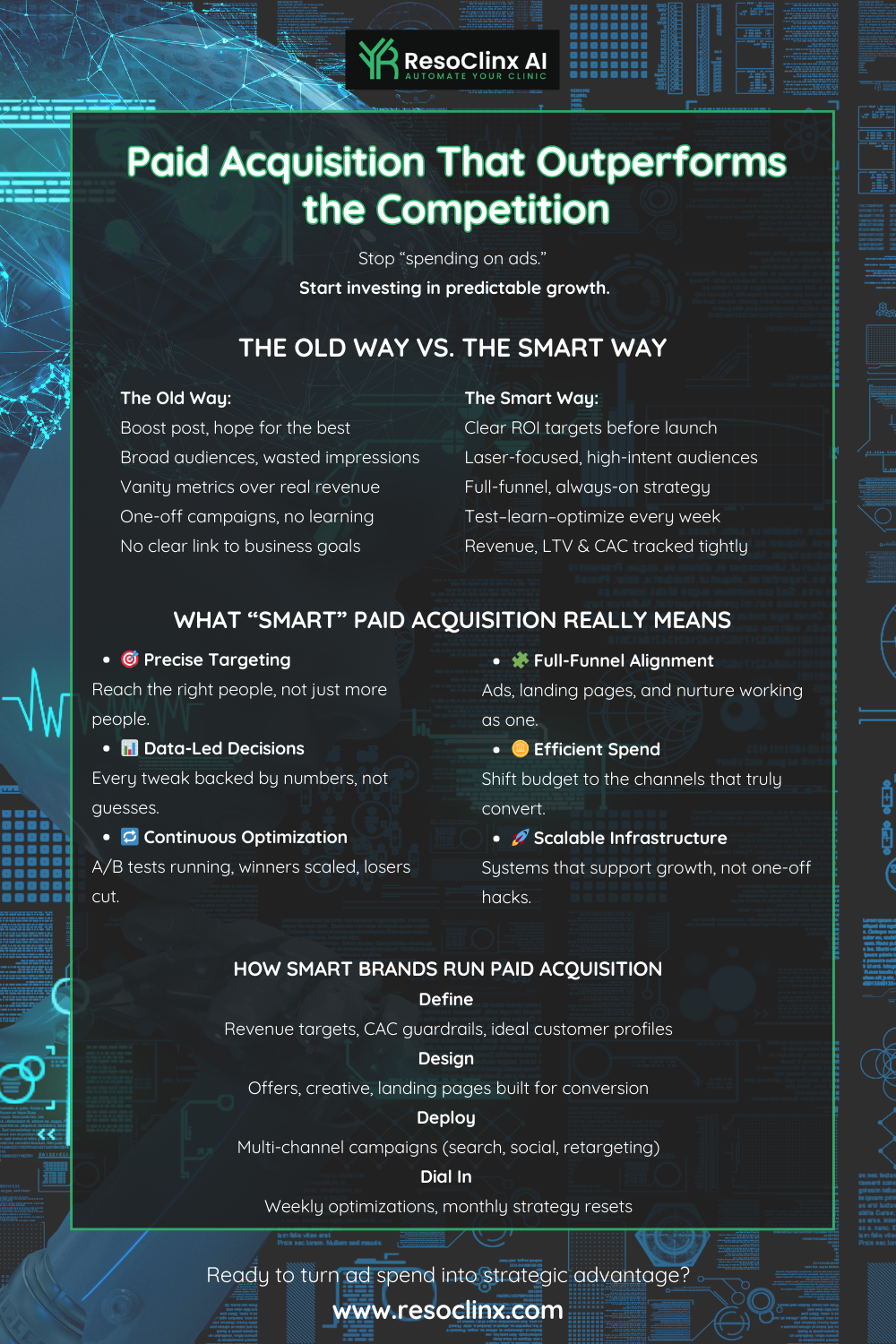
Organic strategies are powerful, but there may be times when you want to amplify your reach with paid ads. The key is to use them strategically, not as the only solution.
Paid advertising works best when it:
targets high-intent audiences,
leads to relevant landing pages, and
is supported by good follow-up.
Targeting High-Intent Audiences Effectively
Think about what people type into search when they are close to making a decision.
They are unlikely to search just for “beauty tips”. Instead, they may search for phrases such as:
“skin clinic in [your town]”
“laser hair removal clinic near me”
“chemical peel treatment [city]”
By focusing on specific, treatment-related, and location-based keywords, your ads can reach people already considering treatment, rather than cold audiences.
On social platforms, you can narrow your audience by:
Location – people within a realistic travel distance.
Demographics – age ranges that align with your typical clients.
Interests and behaviours – skincare, aesthetics, wellness, etc.
This kind of precision ensures your budget is spent on people who are more likely to become clients, rather than broad, unfocused audiences.
Designing Conversion-Focused Landing Pages
If you send ad traffic to a generic homepage, it’s easy for people to get distracted or confused.
Instead, create dedicated landing pages for your main campaigns. A good landing page:
Is tightly aligned with the ad copy and promise.
Focuses on one main action (e.g. “Book a Skin Consultation”).
Includes clear benefits, a brief explanation of the service, and trust elements such as credentials and testimonials.
Minimises distractions such as unnecessary links or menus.
The goal is to make the path from click to enquiry as simple and reassuring as possible.
The Power of Retargeting Warm Audiences
Most people will not book after seeing your ad just once. That’s normal.
Retargeting allows you to show ads to people who have:
visited your website,
engaged with your social media, or
watched a significant portion of your video content.
These people are “warm” leads: they already know you exist and have shown some interest.
Retargeting can:
Remind them of your clinic,
Reassure them with additional information and proof, and
Encourage them to finally book that consultation.
Because you are focusing on a smaller, warmer audience, retargeting is often more cost-effective than constantly chasing brand-new people.
Encouraging Client Loyalty and Referrals
Attracting new clients is important, but retaining existing ones and encouraging referrals is where long-term stability and profitability come from.
A loyal client base:
provides predictable revenue, and
becomes a powerful source of word-of-mouth marketing.
Designing Rewarding Referral Programmes
A structured referral programme gives happy clients a clear reason to recommend you.
You might:
Offer a modest discount or added-value service to both the referrer and the new client.
Provide referral cards or simple digital referral links that clients can share easily.
Track referrals so you can thank your best advocates personally.
The key is to make the process:
Simple to understand,
Easy to use, and
Rewarding enough to encourage action – without undermining the value of your services.
Implementing Client Loyalty Initiatives
Loyalty initiatives recognise and reward clients who choose you repeatedly.
Options include:
Membership or Subscription Models
For example, a monthly skin membership that includes regular treatments, priority booking, or small added benefits. This provides value for the client and predictability for your clinic.Points-Based Loyalty Systems
Clients earn points for treatments or retail purchases and redeem them for discounts or treatment add-ons.Birthday and Anniversary Perks
Sending a personalised message with a small, thoughtful perk on their birthday or the anniversary of their first visit shows clients that they are remembered and valued.
The Impact of Exceptional Client Experiences
No referral or loyalty strategy can compensate for a poor experience. The foundation of everything is the quality of care you provide and how clients feel when they interact with your clinic.
Think about every touchpoint:
How easy is it to contact and book?
Is your clinic environment welcoming and calming?
Do clients feel listened to, respected and well informed?
Do you follow up after treatments to check in and answer questions?
Small touches – remembering a client’s preference, greeting them by name, or checking in after their treatment – create a positive emotional connection. That’s what turns first-time visitors into long-term loyal clients and enthusiastic referrers.
Streamlining Follow-Up for Maximum Conversion
Getting a new enquiry is exciting – but what happens next determines whether that enquiry becomes a booking or disappears.
Many clinics lose potential clients because they respond slowly, or do not follow up at all. A good follow-up process makes your marketing far more effective without increasing ad spend.
The Importance of Rapid Lead Response
When someone submits a form, sends a message, or calls, they are usually at a high point of interest.
If you respond:
Quickly – they feel valued, and you can answer questions while their motivation is still strong.
Slowly – they may book elsewhere or simply change their mind.
Aim to respond to new enquiries as promptly as you reasonably can, during working hours. Even a brief acknowledgement with a clear timeframe for a full response is better than silence.
Automating Follow-Up Processes
As your clinic grows, manually managing every follow-up can become overwhelming. This is where automation tools can help.
You can automate:
Welcome Emails
When someone submits an enquiry or downloads a guide, send a friendly, informative message with next steps.Appointment Confirmations and Reminders
Use automated emails or SMS messages to confirm bookings and reduce no-shows.Post-Treatment Check-Ins
A short message asking how they are feeling, plus a reminder of aftercare instructions, shows you care and helps prevent unnecessary worry.
Automation doesn’t replace personal contact; it supports it, ensuring that no one feels ignored and that your communication is consistent and reliable.
Nurturing Leads Through Multiple Touchpoints
Follow-up isn’t about nagging; it’s about providing relevant, timely support across different channels.
A typical journey might look like:
Initial Contact – Quick response confirming you’ve received their enquiry.
Information Sharing – Send relevant information about the treatment they are interested in, plus how to book.
Nurturing – Over time, share helpful content related to their concerns, such as blog posts or FAQs.
Reminder to Book – A gentle reminder if they haven’t yet scheduled an appointment.
Post-Treatment – Follow-up to check on their progress and suggest appropriate next steps or maintenance.
The aim is to stay present and helpful without overwhelming them – and to show that you understand their journey, from first question to long-term care.
Putting It All Together
Generating leads for your med spa or aesthetic clinic does not have to rely on large ad budgets.
By focusing on:
knowing your ideal client,
creating educational content,
using email and social media to build relationships,
applying paid ads strategically, and
nurturing loyalty and referrals,
you can create a steady flow of qualified enquiries.
Ultimately, it’s about working smarter, not louder – building an online and offline presence that earns trust, answers questions, and makes it easy for clients to choose you when they are ready.