

Running a beauty or aesthetic clinic is rewarding, but are you really getting the most out of your efforts? It is easy to get caught up in day-to-day treatments and forget to look at the bigger picture. Understanding how clients find you, book with you, and return for further treatments is key to sustainable growth.
This guide will show you how to track conversions in your clinic like a pro, so you can turn casual interest into loyal clients, improve your aesthetic clinic marketing, and make better, data-led decisions.
Key Takeaways
Map the full client journey – from first discovering your clinic to becoming a regular. This reveals where people drop off and where they convert.
Use website analytics and CRM systems to see what is working and what is not. Knowing your numbers is half the battle in effective local SEO for clinics.
Attribute bookings to specific marketing efforts, instead of guessing how people found you. This helps you invest your marketing budget wisely.
Make it easy to book – both online and over the phone. A clunky booking process can lose you clients before you have even spoken to them.
Listen to your clients through reviews and feedback. Their experiences are a powerful source of insight for improving services and increasing conversions.
Understanding Your Conversion Funnel
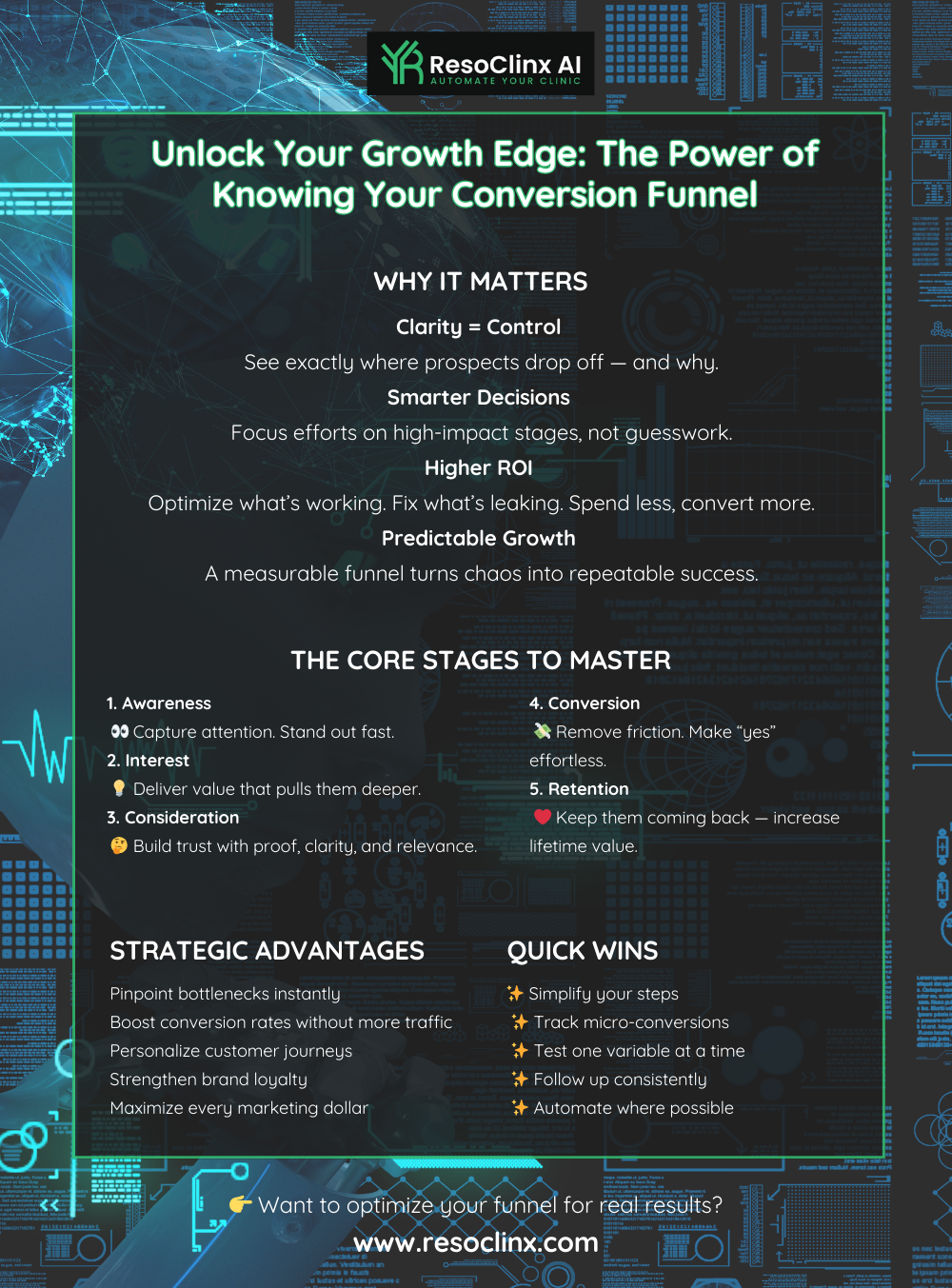
Before you can track conversions, you need to understand what a conversion actually looks like for your clinic. It is not just about a sale; it is about the entire journey a potential client takes from first hearing about you to becoming a loyal, returning client.
Think of this as a path with multiple steps. At each step, there is an opportunity for someone to move closer to booking a treatment – or to drop out. When you understand this funnel, you can start to measure and improve it.
Mapping The Client Journey From Discovery To Booking
Every client’s journey starts somewhere. Maybe they saw an advert on Instagram, found your Google Business Profile in local search results, received a recommendation from a friend, or discovered your website while searching for a specific treatment. This initial discovery is the top of your funnel and a core part of local SEO for clinics.
From there, they might:
Visit your website
Browse your treatment pages
Read your reviews
Check your prices
Look at before-and-after photos
Send an enquiry, call, or use your online booking system
Each step is a micro-conversion that moves them closer to becoming a client.
Here is a typical journey:
Discovery: The client first learns about your clinic (e.g. Google search, Google Business Profile, social media, referral, local advertising).
Consideration: They actively research your services (e.g. visit your website, read reviews, compare other clinics).
Enquiry: They express interest (e.g. fill out a contact form, send a direct message, call the clinic).
Consultation: They book and attend an initial consultation to discuss their needs.
Booking: They commit to a treatment plan and book their first appointment.
Retention: They return for follow-up treatments and maintenance.
By mapping this journey, you can see where people frequently stop, hesitate, or drop off – and then begin to improve those points.
Identifying Key Conversion Points
Within this journey, there are specific moments that signal real progress. These are your key conversion points. For a beauty or aesthetic clinic, conversions are not always just a completed sale.
Key conversion points might include:
Website enquiry form submission – someone took the time to fill out your form.
Phone call to the clinic – a potential client has taken a direct step to speak to you.
Consultation booking – they have committed time to come in and discuss treatment options.
Treatment booking – they have committed to a specific service.
Repeat booking – an existing client returns for another treatment or a maintenance appointment.
Product purchase – they buy skincare or aftercare products, online or in clinic.
Tracking each of these steps gives you a much richer view of how effective your aesthetic clinic marketing and client experience really are.
Defining What A ‘Conversion’ Means For Your Clinic
For tracking to be useful, you must be clear about what counts as a conversion at each stage of your funnel. A “new client booking a treatment” is usually the primary conversion, but intermediate steps are also important.
Examples of conversion definitions for a beauty or aesthetic clinic include:
Primary conversion: A new client books and pays for a treatment.
Secondary conversion: A potential client books a consultation.
Tertiary conversion: A website visitor submits an enquiry form or sends a direct message.
Product conversion: A client purchases a retail product from your online shop or in-clinic display.
Retention conversion: An existing client books a follow-up or maintenance treatment.
When you define these clearly, you can measure progress at every stage, not just the final booking. This makes your data far more actionable.
Implementing Robust Tracking Mechanisms
Once you understand the client journey and your key conversion points, the next question is: how do you actually track what is happening?
Without proper tracking, you are effectively working in the dark. With the right tools, you can see where people are dropping off, which channels perform best, and where to focus your efforts to attract more clients.
Leveraging Website Analytics For Insight
Your website is often the first digital touchpoint a potential client has with your clinic. Tools like Google Analytics 4 (GA4) or similar website analytics platforms are invaluable.
They can show you:
Traffic sources: Which channels (organic search, local SEO via Google Business Profile, paid adverts, social media, email, direct visits) are bringing people to your website.
User flow: The path visitors take through your site – for example, from the home page to a treatment page and then to the booking page.
Engagement and bounce rates: Where people stay and where they leave quickly, which can highlight content that is confusing or unhelpful.
Conversion events: Actions such as enquiry form completions, clicks on your “Book now” button, or completed online bookings.
By setting up conversion events in your analytics, you can see which pages, blog posts, or marketing campaigns actually lead to enquiries and bookings, rather than just page views.
Utilising CRM Systems For Client Data
While website analytics show what happens on your site, a Customer Relationship Management (CRM) system shows what happens with real clients over time.
A good CRM allows you to track:
Lead source: Where each enquiry came from (e.g. Google search, Google Business Profile, Instagram, referral, leaflet).
Communication history: Emails, calls, notes from consultations, and follow-ups.
Appointment status: Scheduled, attended, cancelled, or no-show.
Conversion status: From first enquiry to consultation, treatment booking, and repeat booking.
This gives you a clear view of quality as well as quantity. You are not just counting how many enquiries you receive, but how many become paying, returning clients.
A common pitfall is only tracking initial enquiries. To really understand your conversion performance, you need to follow each lead all the way through to a confirmed booking and beyond.
Integrating Online And Offline Tracking
Many clients will interact with your clinic both online and offline. For example, someone might:
See a social media advert
Visit your website
Check your Google Business Profile reviews
Then call to book an appointment
To understand this full journey, you need to connect the dots between online and offline activity.
Useful tools and processes include:
Call tracking: Use unique phone numbers for different campaigns (e.g. one for your website, one for local print advertising). This shows which channels generate calls.
Unique promo codes: Add specific codes to offline materials (e.g. leaflets, local magazines) that clients quote when booking. This makes offline conversions easier to track.
Staff training: Train your reception or booking team to always ask “How did you hear about us?” and record the answer in your CRM or booking system.
By combining these techniques, you get a far clearer view of which parts of your aesthetic clinic marketing are genuinely driving bookings.
Measuring The Impact Of Marketing Efforts
You may be investing in social media, local SEO, paid adverts, or email campaigns, but how do you know what is actually working? Measuring impact means going beyond “this looks busy” and into data you can rely on.
Attributing Bookings To Specific Campaigns
The goal of attribution is to link actual bookings back to specific campaigns or channels.
You can do this by:
Using website analytics to see how traffic and conversions change when a campaign is running (for example, a spike in bookings from social media after promoting a new treatment).
Using unique promo codes in leaflets or email campaigns so you can see how many bookings came from that specific activity.
Asking clients how they heard about you and capturing that consistently in your CRM.
Using call tracking numbers for different campaigns so phone bookings can be tied back to particular adverts or pages.
When you know which campaigns lead to actual bookings, not just clicks or impressions, you can allocate your marketing budget more confidently.
Calculating Return On Investment For Marketing Spend
Once you know which campaigns generate bookings, the next step is to understand whether they are financially worthwhile. This is where Return on Investment (ROI) comes in.
A simple approach to calculating ROI looks like this:
Total revenue from the campaign: Add up the income generated from clients who booked as a direct result of a specific marketing effort.
Total cost of the campaign: Include ad spend, design, printing, and staff time.
ROI formula:
((Totalrevenuefromcampaign−totalcostofcampaign)÷totalcostofcampaign)×100((Total revenue from campaign − total cost of campaign) ÷ total cost of campaign) × 100((Totalrevenuefromcampaign−totalcostofcampaign)÷totalcostofcampaign)×100
For example, if you spend £500 on a social media advert that brings in 10 new clients, and each client spends £200 with you, that is £2,000 in revenue.
Your ROI would be:
((£2,000−£500)÷£500)×100=300((£2,000 − £500) ÷ £500) × 100 = 300%((£2,000−£500)÷£500)×100=300
This means that for every £1 spent, you made £3 in return. If a campaign has a negative ROI, it is a sign that the activity may need to be adjusted or replaced.
Analysing Lead Quality Over Quantity
It is tempting to focus on getting as many leads as possible, but more is not always better. What really matters is lead quality.
When you assess lead quality, consider:
Demographics: Do your leads match your ideal client profile? For example, if you specialise in advanced skin rejuvenation for clients over 40, but most enquiries are from younger people looking for budget treatments, your targeting may be off.
Engagement level: Did they simply click a button, or did they read information, ask questions, and attend a consultation?
Conversion rate: What percentage of leads from each source become paying clients? A smaller volume of high-quality leads from one source may be more valuable than lots of poor-quality leads from another.
Client lifetime value: Some clients might start with a single treatment but eventually book courses of treatment or regular maintenance. These long-term relationships are extremely valuable.
By focusing on quality over quantity, you ensure your sales pipeline is filled with people who are more likely to book, return, and recommend you.
Optimising For Higher Conversion Rates
Once you are tracking your funnel and measuring performance, the next step is optimisation – improving the experience at each stage so more people convert.
Small improvements can make a significant difference. If you increase your conversion rate from 20% to 25%, you gain more clients without increasing your marketing spend.
Streamlining The Appointment Booking Process
Your booking process is often the most critical step. Even if people love your brand and treatments, a confusing or time-consuming booking experience can put them off.
To streamline booking:
Ensure there is a clear “Book now” or “Enquire now” button on every page of your website.
Offer multiple ways to book, such as online booking, telephone, and email.
Keep online forms short and simple, asking only for essential details.
Make sure your phone number is easy to find and clickable on mobile.
Confirm bookings with clear email or SMS reminders to reduce no-shows.
A straightforward, well-signposted booking process is one of the easiest ways to increase conversions and attract more clients from your existing traffic.
Enhancing Landing Page Effectiveness
When someone clicks on an advert or a social media post, they usually land on a specific page. That page – your landing page – has one job: to encourage the next step (usually an enquiry or booking).
A strong landing page for an aesthetic clinic typically includes:
A clear, benefit-led headline – for example, “Advanced Skin Rejuvenation for Natural-Looking Results”.
Concise, reassuring body copy that explains the treatment, what to expect, and who it is suitable for.
High-quality visuals – such as clinic images or before-and-after photos (with permission).
A prominent call to action (CTA) – “Book your consultation” or “Request a skin assessment”.
Social proof – ratings, short testimonials, or review snippets to build credibility.
Key elements to check:
Headline: Does it clearly communicate the main benefit?
Body copy: Does it answer common questions and remove doubts?
Visuals: Do they build trust and look professional?
CTA: Is it obvious what to do next?
Social proof: Is there evidence that other clients trust and recommend you?
When all of these elements work together, your landing pages become powerful conversion tools, not just information pages.
Element | Description |
|---|---|
Headline | Grabs attention and states the main benefit. |
Body Copy | Explains the offer and addresses potential concerns. |
Visuals | Images or videos that showcase results and build trust. |
Call to Action (CTA) | Clear instruction on what the visitor should do next. |
Social Proof | Testimonials, reviews, or case studies to build credibility. |
Refining Your Client Consultation Experience
For many clinics, the consultation is the make-or-break stage. It is where you:
Build trust and rapport
Understand the client’s concerns and goals
Explain your recommendations and set realistic expectations
To make consultations more effective:
Actively listen and allow clients time to share their concerns.
Ask structured, insightful questions about their medical history, skincare routine, and lifestyle.
Explain treatments in clear, non-technical language, including benefits, potential side effects, and realistic outcomes.
Provide written or digital aftercare and next steps so they do not feel overwhelmed.
Follow up with a summary email or message, especially if they need time to decide.
A professional, reassuring, and informative consultation not only improves conversion rates but also supports ethical, client-centred care.
Leveraging Client Feedback For Improvement
Client feedback is one of the most valuable sources of data you have. It reveals how people actually experience your clinic, beyond what you see in your systems and reports.
Gathering and Analysing Reviews
Most clients will not leave a review unless prompted, so building a simple, consistent process to request feedback is essential.
You might:
Send an automated email or SMS 24–48 hours after an appointment with a polite request for feedback.
Provide a direct link to your preferred review platform, such as Google reviews, to make leaving a review quick and easy.
Encourage clients to comment on specific areas such as staff friendliness, treatment experience, and overall results.
When reviews start coming in, look for patterns and themes, such as:
What clients love most (e.g. particular practitioners, atmosphere, specific treatments).
Recurring complaints, such as waiting times or difficulty booking.
Feedback linked to specific services, such as injectables, facials, or laser treatments.
By regularly reviewing this feedback, you can understand where you excel and where you need to improve.
Using Testimonials to Build Trust
Reviews can also be turned into testimonials that build trust with new visitors. People tend to trust the experiences of others more than marketing claims.
You can:
Feature short testimonials on key pages of your website, including treatment pages.
Share selected testimonials (with consent) on social media, paired with imagery that reflects your brand.
Include testimonials in email newsletters or information packs for new clients.
The most effective testimonials are specific – for example, a client describing how a course of treatments improved their confidence or how they felt looked after during the process.
When used thoughtfully, testimonials help potential clients feel more comfortable about booking with your clinic for the first time.
Turning Feedback Into Actionable Insights
Collecting feedback is only useful if you act on it.
A practical approach is:
Review feedback regularly – for example, once a week or once a month.
Identify recurring issues or suggestions – such as difficulty reaching the clinic by phone, or frequent praise for a particular practitioner.
Discuss findings with your team, and decide on clear actions (e.g. improving phone coverage, updating the booking system, refining aftercare information).
Implement and monitor changes to see if they improve client satisfaction and conversion rates.
Communicate improvements – if appropriate, let clients know you have made changes based on feedback; this shows you listen and care.
Over time, this creates a culture of continuous improvement, which supports both better client experience and better conversion performance.
The Role Of Technology In Conversion Tracking
In today’s digital landscape, relying solely on manual tracking is like navigating a busy city with a paper map. Technology gives you faster, more accurate, and more detailed information about your client journey – from first discovery to repeat bookings.
The key is to choose tools that work together so you can see a unified picture of your marketing, bookings, and client behaviour.
Exploring Clinic Management Software
Clinic management software (CMS) has become the backbone of many modern aesthetic clinics. Beyond basic appointment scheduling, these systems often provide:
Integrated client records with treatment history and notes
Booking management for in-clinic and online appointments
Reminders and follow-ups via email or SMS
Basic reporting on bookings, cancellations, and revenue
From a conversion tracking perspective, a CMS can log:
When a new client enquires
When they book a consultation
When they attend and pay for a treatment
Whether they rebook or return for maintenance
Some systems also allow you to record lead sources and create custom fields (e.g. treatment of interest, key concerns), which makes it easier to analyse which services and channels perform best.
Utilising Marketing Automation Tools
Marketing automation tools work alongside your website and CRM to help you respond quickly to enquiries and nurture leads over time.
For example, when someone fills in a contact form on your website:
An automated tool can send a personalised thank-you email.
It can notify your team to follow up by phone or email.
It may add the person to a relevant email sequence (for example, a series explaining your skin consultation process or highlighting common treatment questions).
You can also:
Send education-focused email content about skin health, treatment options, and aftercare.
Segment your audience by interests or treatment type to make your messages more relevant.
Automate reminders for consultations, patch tests, or follow-up appointments.
Used well, marketing automation keeps your clinic visible and helpful without overwhelming clients with sales-heavy messages.
Staying Ahead With Emerging Technologies
New technologies continue to create opportunities to improve conversion tracking and client experience.
Examples include:
AI-powered chatbots on your website that answer common questions and guide visitors towards booking.
Heatmap and session recording tools that show where users click, scroll, and get stuck on your website, highlighting areas for improvement.
More advanced call tracking and attribution tools that can link phone enquiries back to specific campaigns, keywords, or landing pages.
The aim is not to collect as much data as possible, but to collect meaningful data that you use. If you regularly review the insights from your technology stack, you will spot patterns and opportunities that manual tracking would simply miss.
Putting It All Together for Success
Tracking conversions may sound technical at first, but in practice it is about understanding what works and what does not for your clinic.
By:
Mapping your client journey
Defining clear conversion points
Using website analytics, CRM, and clinic software
Measuring marketing impact and ROI
Improving booking, landing pages, and consultations
Listening carefully to client feedback
…you move from guesswork to evidence-based decision-making.
Every effort you put into attracting more clients – from your Google Business Profile and local SEO for clinics to your email campaigns and in-clinic experience – can then be measured, refined, and improved over time.
When you treat conversion tracking as an ongoing process, it becomes a powerful way to guide your aesthetic clinic marketing and support long-term, sustainable growth.