Thinking about how to create a med spa or aesthetic clinic advert that actually leads to bookings? It’s not as complicated as it can seem, and you don’t need an expensive agency to make it work. In this guide, we’ll break down how to get your message in front of the right people and turn clicks into consultations, without blowing your budget or needing a marketing degree.
The aim is simple: help your clinic attract more of the right clients in a sustainable, ethical and compliant way.
Key Takeaways
- Understand who you’re trying to reach and what they’re looking for. Tailor your ad copy to speak directly to their desires and highlight the real, realistic transformations your treatments can provide.
- Choose the right places to advertise. Google Ads work well for people actively searching, while Meta platforms (Facebook, Instagram) are ideal for visual storytelling and building awareness.
- Make your ads look professional. Use high-quality images and videos that showcase genuine client results (for non-prescription treatments) and create a calm, reassuring feel for your clinic.
- Set a sensible budget and track the numbers. Start small, understand your Cost Per Lead (CPL) and returns, and then scale your campaigns based on what is working.
- Track everything. Know which ads are bringing in leads and bookings, and use that information to improve your campaigns over time.
Crafting Compelling Med Spa Ad Copy
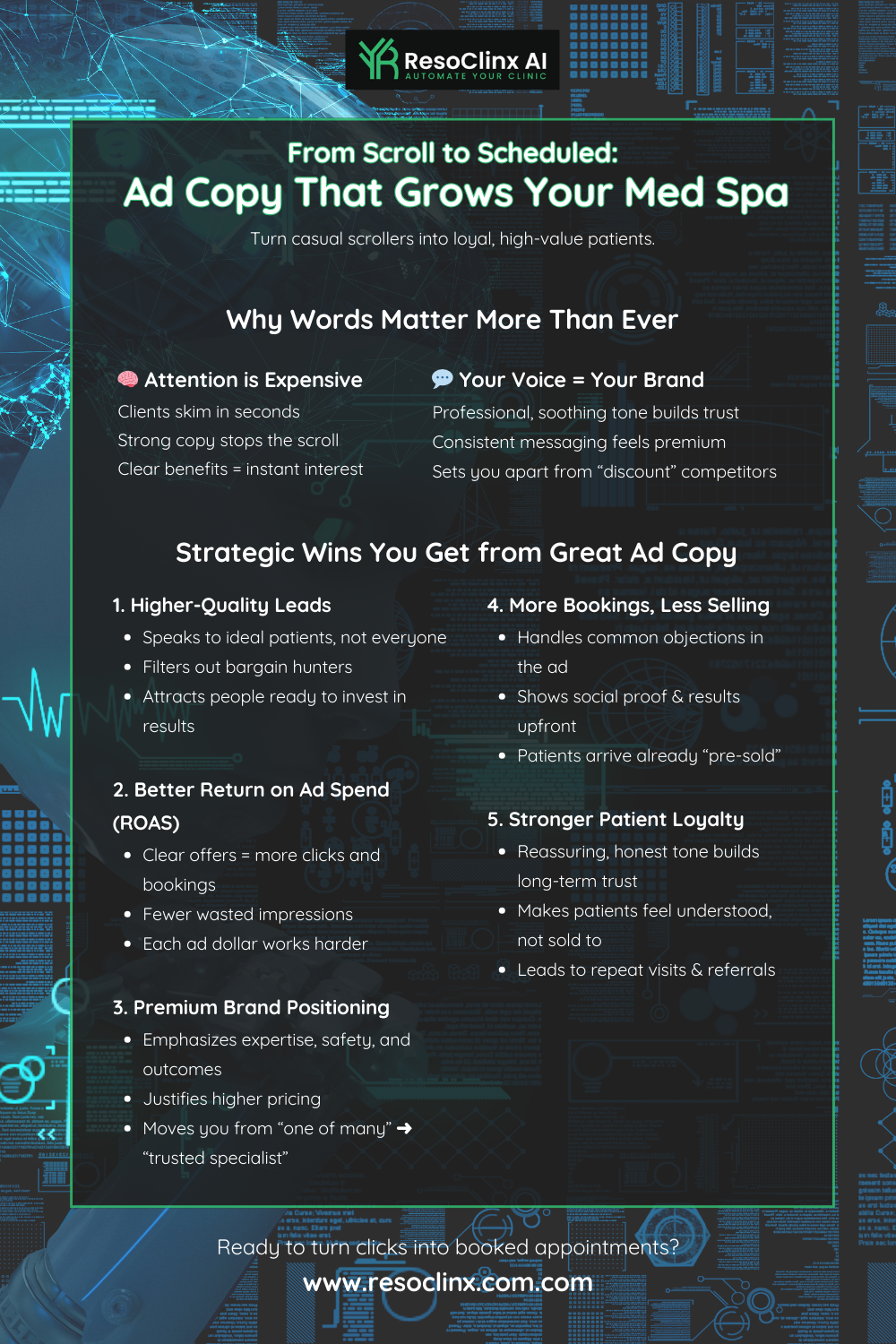
When people see your advert, you want them to pause and think, “That’s exactly what I need.” Your words have to work hard. It’s not just about listing services; it’s about speaking directly to what your potential clients want to change and the problems they want to solve.
Understanding Your Ideal Patient’s Desires
Before you write a single line of copy, take a moment to think carefully about who you are trying to reach.
Ask yourself:
- What are they looking for when they search for treatments like yours?
- Are they hoping to look more rested, feel more confident, or address a specific concern such as skin texture, pigmentation or stubborn fat?
- How does their lifestyle affect the type of treatment they are willing to consider?
You can think about this in three simple areas:
- Pain Points: What frustrates them about their current appearance or routine?
Examples: “tired-looking eyes”, “skin that feels dull”, “spending too much time shaving”. - Aspirations: What do they hope to achieve?
Examples: “a smoother complexion”, “feeling more youthful”, “looking refreshed for an event”. - Lifestyle: How do your treatments fit into their day-to-day life?
Examples: “quick treatments with minimal downtime”, “results that last through a busy schedule”.
Understanding these core desires allows you to tailor your message so it feels personal and relevant.
Instead of simply saying, “We provide anti-wrinkle treatments”, you might say:
“Tired of looking tired? Our medical aesthetics team can assess your lines and wrinkles and recommend evidence-based treatments for a refreshed, natural look.”
This connects with their emotional needs while staying professional and compliant.
Highlighting Unique Benefits and Transformations
What makes your med spa or aesthetic clinic stand out? Listing services is easy, but the real impact comes when you focus on results and experience.
Consider:
- Transformations, not just treatments. What changes do your clients notice in their confidence, skin or daily routine?
- Experience and expertise. Do you have medically qualified practitioners, advanced technologies or a particularly calm, supportive environment?
- Reassurance. Are your consultations thorough and honest, with clear expectations and aftercare?
Some useful angles:
- Before & After (non-prescription treatments):
For treatments such as skin rejuvenation, laser hair removal or body contouring, carefully presented before-and-after images can be powerful. Ensure they are well-lit, realistic and professional, and always comply with UK advertising rules for non-prescription treatments. - Unique Selling Points (USPs):
Do you offer a signature facial, a bespoke skin programme, or a particular technology that others in your area do not? Highlight that clearly. - Client Testimonials:
Real words from happy clients help build trust. Short, specific quotes about how they felt after treatment can be very effective.
For example, instead of “Facial treatments available”, you might say:
“Reveal your most radiant skin. Our signature facial combines advanced techniques to deeply cleanse, hydrate and revitalise, leaving you with a noticeable glow.”
This description focuses on benefits, not just the procedure itself.
Using Persuasive Language and Clear Calls-to-Action
Once you know your audience and the benefits you want to highlight, the next step is to make your copy compelling and actionable.
Key elements:
- Benefit-Oriented Language:
Focus on what the client gains: confidence, clarity, smoother skin, more time, peace of mind. - Gentle Urgency (used sparingly):
Time-limited offers or limited spaces can encourage people to act, but avoid sounding pushy.
Example: “Book your consultation this week to secure introductory pricing on our new skin rejuvenation programme.” - Clear Calls-to-Action (CTAs):
Make it obvious what you want them to do next. A good CTA is specific and simple, for example:- “Book Your Skin Consultation Online”
- “Enquire About Treatment Options”
- “Download Our Treatment Guide”
Your ad copy acts as a bridge between your patient’s current concerns and their desired outcome. Make it easy for them to take the next step.
Here’s a quick look at how different offers can be phrased:
| Offer Type | Example Ad Copy |
|---|---|
| Discount | “Save £50 on your first HydraFacial! Limited spots available this month.” |
| Free Consultation | “Curious about injectables? Book a complimentary, no-obligation consultation.” |
| Package Deal | “Get glowing skin: Buy a package of 3 laser facials, get the 4th free!” |
| New Client Perk | “First time with us? Enjoy 15% off any treatment when you book today.” |
The goal is to make your advert so appealing and clear that booking a consultation feels like the natural next step.
Selecting The Right Advertising Platforms
Choosing where to run your ads is just as important as what they say. Different platforms reach people at different stages of their decision-making journey.
Leveraging Google Ads for High Intent Searches
When someone is actively searching for a specific treatment, such as “laser hair removal” or “skin rejuvenation clinic near me”, Google is often where they start.
This is where Google Ads can be particularly powerful. They place your aesthetic clinic directly in front of people who are already looking for services like yours.
With Google Ads, you can:
- Target specific keywords related to your treatments and location.
- Show ads only to people searching within your catchment area.
- Reach people when they already have high intent and are close to making a decision.
Think of it like this: you’re not interrupting someone’s day; you’re appearing at the moment they have actively raised their hand and said, “I’m looking for this service.”
Utilising Meta Platforms for Visual Storytelling
Meta platforms, including Facebook and Instagram, are excellent for visual storytelling and building awareness. People scroll here to relax, be inspired and discover new ideas.
On these platforms, you can:
- Showcase before-and-after images for non-prescription treatments (e.g. skin rejuvenation, body contouring) in a professional way.
- Share short videos of treatments, behind-the-scenes content, or clips explaining what to expect in a consultation.
- Introduce your team, clinic environment and values, building trust before anyone books.
Useful ad types include:
- Lead Ads:
Ideal for quickly collecting contact details without users leaving the platform. This works well for consultation requests or event sign-ups. - Conversion Ads:
Drive people to a dedicated landing page on your website designed for booking or enquiry. Make sure your tracking (such as Meta Pixel) is correctly set up so you can see which ads lead to enquiries and bookings. - Carousel & Video Ads:
Use carousels to highlight multiple treatments or stages of a treatment journey. Short videos work well for explaining how a treatment works or showing a calm, professional treatment experience.
Authenticity is crucial. Real client stories, real team members and real clinic imagery consistently perform better than generic stock photos.
Considering Local Awareness Campaigns
For a local business like a med spa or aesthetic clinic, ensuring that people in your immediate area know you exist is crucial.
Local awareness campaigns help you:
- Reach people who live or work within a certain radius of your clinic.
- Promote new treatments, seasonal offers or open days to a nearby audience.
- Reinforce your presence so that when someone thinks about aesthetic treatments, your clinic comes to mind first.
These campaigns are particularly effective when combined with strong local SEO and an optimised Google Business Profile, so that people who see your ad and then search for you can easily find accurate information, reviews and directions.
Designing Visually Appealing Advertisements
When people scroll through their feeds, your ad has only a second or two to catch their eye. Strong visuals help your audience quickly understand:
- What you do
- Who you help
- The type of results they can expect
This is not about flashy design for its own sake. It’s about communicating trust, quality and professionalism.
Showcasing Authentic Client Transformations
People want to see real results from real people. Carefully chosen visuals can help potential clients imagine themselves achieving similar outcomes.
Focus on:
- Non-prescription treatment results: For example, skin resurfacing, facials, laser hair removal or body contouring.
- Clarity and realism: Images should be clear, well-lit and free from heavy filters or misleading edits.
- Consent and respect: Always gain written consent from clients before using their images and present them in a respectful, professional way.
Types of visual content that work well:
- Before-and-after photos (for non-prescription treatments)
- Short testimonial videos where clients describe how they felt after their treatment
- Lifestyle imagery of confident, relaxed clients that reflect the outcome of your services
Creating a Calming and Professional Aesthetic

Your ad should reflect the atmosphere of your clinic. Most patients are looking for an environment that feels calm, hygienic and reassuring, not cold or overly clinical.
Consider:
- Colour Palette: Use colours that match your brand and convey calm, such as soft neutrals or muted tones.
- Lighting: Natural or soft professional lighting makes a significant difference to how inviting your imagery feels.
- Environment: If you show your clinic, ensure treatment rooms and waiting areas appear clean, organised and welcoming.
A visually cohesive look across your ads and website helps build brand recognition and trust.
Utilising High-Quality Imagery and Video
Poor-quality visuals can undermine even the best-written ad copy. Investing in good photography and video is a key part of professional aesthetic clinic marketing.
Aim for:
- High Resolution: Images and videos should remain sharp on both mobile and desktop.
- Thoughtful Editing: Subtle editing to correct lighting or colour is helpful, but avoid anything that makes results look unrealistic.
- Format Variety: Use a mix of static images, short vertical videos and carousels to show different aspects of your services and client journeys.
Your visuals are often the first impression someone has of your clinic. Make sure they clearly communicate quality and care.
Optimising Your Advertising Budget Effectively
It’s easy to start running ads and increasing spend quickly, but without a plan you can burn through budget without seeing much return. The goal is to treat your ad spend as an investment, not just a cost.
Every pound should be working to:
- Bring in qualified enquiries
- Generate booked consultations
- Ultimately support sustainable growth for your clinic
Setting Realistic Budget Tiers for Growth
There is no single “correct” budget for every med spa or clinic. It depends on:
- Your location and local competition
- The treatments you offer
- How aggressively you want to grow
As a rough guide:
- A new clinic may allocate a higher percentage of projected revenue (e.g. 20–40% initially) to build awareness quickly.
- A more established practice might spend 5–10% of revenue on ongoing ads to maintain and grow their client base.
For many small clinics, a starting range of £1,000 to £10,000 per month across platforms like Google and Meta can provide enough data to see what works, without over-committing.
Starting Small and Scaling Based on Performance
A focused approach is usually best at the beginning. Rather than launching lots of campaigns at once, start with:
- One specific treatment or offer
- One primary audience (e.g. women aged 30–55 within a set radius)
- One geographic area
You might begin with a daily budget of £25–£50. This is often enough for the platforms to start learning who responds to your ads.
Once you see which ads and audiences are generating genuine leads and bookings, you can gradually shift more budget towards those campaigns. Think of it as watering the areas of the garden that are already growing.
Tracking Cost Per Lead and Return on Investment
Numbers help you stay objective. Even if you love a particular advert, you need to know whether it’s actually working.
Key metrics to track:
- Cost Per Lead (CPL):
How much you spend in ads to generate a single enquiry or lead. - Booking Rate:
Out of all the leads you receive, how many convert into appointments? - Return on Ad Spend (ROAS):
How much revenue your ads generate compared to what you spent.
Here’s a rough guide to average CPL ranges you might see (these will vary by clinic and market):
| Service Type | Average Cost Per Lead (GBP) |
|---|---|
| Botox/Dysport | £20 – £40 |
| Filler Packages | £30 – £60 |
| Body Sculpting | £40 – £75 |
| Consultation/Event | £1.50 – £5.00 |
If your CPL is too high or leads aren’t converting into bookings, it’s a signal to refine your targeting, messaging or follow-up process. When a campaign consistently generates affordable leads that become paying patients, that’s when it makes sense to scale your spend gradually.
Implementing Smart Campaign Strategies

Running ads without a clear strategy is risky; you might see some results, but they will often be inconsistent and difficult to repeat. A structured approach helps you turn your advertising into a repeatable, predictable system.
Defining Clear Campaign Goals and Objectives
Before you choose images or write copy, answer one question:
“What do I want this campaign to achieve?”
Common goals for med spa and aesthetic clinic campaigns include:
- Lead Generation:
Collecting contact details for people interested in particular treatments (e.g. skin tightening, body contouring, injectable consultations). - Direct Bookings:
Encouraging immediate online bookings for consultations or specific treatments. - Event Promotion:
Filling places for open days, educational evenings or new treatment launches. - Brand Awareness:
Increasing local awareness of your clinic so that people think of you first when they’re ready to book.
Match your goal to the campaign type. For example:
- Use Lead Generation objectives for campaigns focused on enquiry forms or in-platform lead forms.
- Use Conversion objectives when you want people to complete an online booking or consultation request on your website.
Avoid getting distracted by vanity metrics like likes or impressions. The real measure of success is how many qualified bookings and paying patients your campaign generates.
Developing Irresistible Offers and Packages
People rarely book simply because a treatment exists; they book when there is a clear reason to act now.
Strong offers often include:
- Limited-Time Incentives:
For example, introductory pricing for a new skin treatment for a defined period. - Packages and Programmes:
Bundling complementary treatments into a structured programme can provide better results and more value for the patient. - First-Time Patient Incentives:
A modest saving or added value for new patients who attend a consultation and proceed with treatment. - Seasonal Promotions:
Skin and body treatments tied to specific times of year (e.g. “summer skin preparation” or “post-holiday skin reset”).
Make sure each offer:
- Is easy to understand
- Clearly states who it’s for
- Emphasises the benefit, not just the discount
For example:
“Save £50 on your first HydraFacial when you book a consultation this month. Ideal for tired, dehydrated skin that needs a boost.”
The Power of Retargeting for Conversion
Not everyone who sees your ad or visits your website will book straight away. Many people:
- Browse treatment information
- Look at your pricing
- Check your social media
- Then get distracted
Retargeting allows you to re-engage people who have already shown interest.
Steps to implement:
- Install tracking (e.g. Meta Pixel, Google Ads tag) on your website.
- Create custom audiences of visitors who viewed key pages (e.g. treatment pages, pricing, booking page) but didn’t book.
- Run retargeting ads specifically to this warm audience, perhaps with:
- Additional information
- Testimonials
- A gentle reminder to book
- A small time-limited incentive
Retargeting audiences often convert at a much higher rate than cold audiences because they already recognise your clinic and have taken a first step towards enquiring.
Ensuring Seamless Appointment Booking
Once someone clicks your ad, the experience must feel smooth and straightforward. If booking feels difficult or confusing, many potential patients will simply give up and move on.
Streamlining the Online Booking Process
Your website should make it obvious and easy to book.
Helpful steps:
- Place a clear “Book Now” or “Request a Consultation” button in your header, footer and on key treatment pages.
- Use a simple, mobile-friendly booking system that shows real-time availability.
- Keep forms short and focused on essential information only.
- Ensure the booking process works seamlessly on mobile devices, as many users will come from social media apps on their phones.
A patient should be able to arrive from an ad and:
- Immediately recognise they are in the right place
- Understand the treatment or offer
- Book or enquire in a few simple steps
Integrating Ad Clicks with Your Booking System
Where possible, send people from your ads to highly relevant landing pages, not just the homepage.
For example:
- An ad about skin rejuvenation should take people to a page focused on that topic, with clear information and a visible booking or enquiry option.
- An ad inviting people to a consultation should land on a page explaining what happens in that consultation and what they can expect.
Some booking systems also allow you to track the source of each booking, helping you see which campaigns deliver the most appointments.
The guiding principle is to reduce friction. The fewer steps between clicking and booking, the better.
The Power of Prompt Lead Follow-Up
Not every lead will book online immediately. Some people will:
- Fill in a contact form
- Call the clinic
- Send a message on social media
For these enquiries, speed of follow-up is crucial. Clinics that respond within minutes, not days, consistently see better conversion rates.
A simple follow-up structure:
- Instant Automated Response:
An automatic email or SMS acknowledging their enquiry and explaining when they’ll hear from you. - Personalised Outreach:
Aim for a phone call or personalised message within 15–30 minutes during working hours where possible. - Nurture Sequence:
If they don’t book straight away, send a small sequence of helpful follow-up messages over the next few days, sharing:- Answers to common questions
- Links to treatment information
- Invitations to schedule a consultation
- Track Outcomes:
Record whether each lead is contacted, booked, rescheduled or not proceeding. Over time, this helps you refine your process and improve conversion.
Measuring Ad Performance and Iterating
Once your ads are active, the most important work is ongoing: measuring, learning and improving. A “set and forget” mindset is one of the quickest ways to waste money.
To make a real difference to your bookings, review what is happening regularly and adjust based on what you find.
Tracking Key Performance Indicators
Rather than focusing on likes or comments, pay attention to the metrics that directly affect bookings and revenue.
Key indicators include:
- Cost Per Lead (CPL):
How much you are spending in ads to generate a single enquiry. This figure should be sustainable for your clinic. - Booking Rate:
Of all the leads received, what percentage actually book a consultation? A low booking rate often points to issues in your follow-up or booking process. - Conversion Rate:
Of those who attend consultations, what percentage proceed to treatment? This shows how effective your overall patient journey is. - Return on Ad Spend (ROAS):
How much revenue is generated as a direct result of the ad campaigns compared to what you spent. A positive ROAS over time indicates that your ads are functioning as an asset to the business.
Reviewing these metrics weekly or monthly gives you a clear dashboard of how your advertising is performing.
Analysing What Works and What Doesn’t
Once you have data, look for patterns:
- Which visuals performed best?
Did certain images or videos get more clicks or leads? - Which headlines and messages resonated?
Were people more responsive to offers, or to educational messaging? - Which audiences responded well?
Consider age, location, interests or behaviours. - Which platforms delivered the most valuable leads?
For some clinics, Google may deliver higher intent; for others, Instagram may be better at generating enquiries.
Also look at where in the journey people drop off:
- Are they clicking the ad but not completing the form?
- Are they completing the form but not booking when contacted?
These insights show you exactly where to improve.
Continuously Refining Your Ad Strategy
Data is only useful if you use it to make changes. Over time, your goal is to build a continuous improvement cycle.
Practical ways to refine:
- A/B Testing:
Test different versions of your ads by changing one element at a time—such as the headline, image, or CTA—and see which performs better. - Budget Allocation:
Shift more of your budget towards campaigns and ad sets that consistently bring in affordable, high-quality leads. Reduce or pause anything that isn’t working. - Gradual Scaling:
When you have a campaign that is clearly performing well, increase the budget slowly (for example, by 20–25% at a time) to check it holds performance at higher spend. - Ongoing Retargeting:
Continue retargeting people who visited your website or booking pages but did not book. This warm audience often converts at a higher rate than completely new visitors.
Over time, this approach turns your advertising into a repeatable system rather than a series of one-off experiments.
Putting It All Together
Creating advertising that consistently brings in new patients does not require a huge budget or a large agency. It requires:
- A clear understanding of your ideal patient
- A message that speaks to their needs and aspirations
- Professional, authentic visuals
- A smooth, simple booking process
- A willingness to measure, learn and refine
In this guide, we’ve covered how to:
- Craft compelling med spa ad copy
- Choose the right platforms for your aesthetic clinic marketing
- Design visuals that communicate trust and quality
- Set and optimise your advertising budget
- Build offers and strategies that encourage people to enquire and book
- Track performance so you can improve over time
The clinics that perform best treat their advertising as an ongoing process, not a one-off project. They test, measure, learn and adjust.
If you focus on clear objectives, compliant messaging and a good patient experience, your campaigns can become a sustainable asset that supports steady growth for your practice—without needing an agency to do it for you.